



Burdens of Proof in Criminal Law
Burden of proof in criminal cases refers to the legal obligation placed on a party to establish the truth of a disputed fact to a standard required by law. In criminal proceedings specifically, this obligation falls on the prosecution, which must prove every element of the alleged offense relevant to the defendant's guilt. The defendant, by contrast, enters the proceeding presumed innocent, a principle expressed in the Latin maxim ei incumbit probatio qui dicit, non qui negat, meaning "the burden of proof rests on who asserts, not on who denies".
The standard the prosecution must meet in a criminal case is proof beyond a reasonable doubt, which stands as the highest evidentiary threshold in Anglo-American jurisprudence. This standard requires that no other logical explanation can be derived from the facts except that the defendant committed the crime charged. It does not demand absolute certainty; rather, it demands proof of such a convincing character that a rational trier of fact would rely and act upon it without hesitation. Consequently, if even a reasonable doubt remains after examining all evidence, the trier of fact must return a verdict of not guilty.
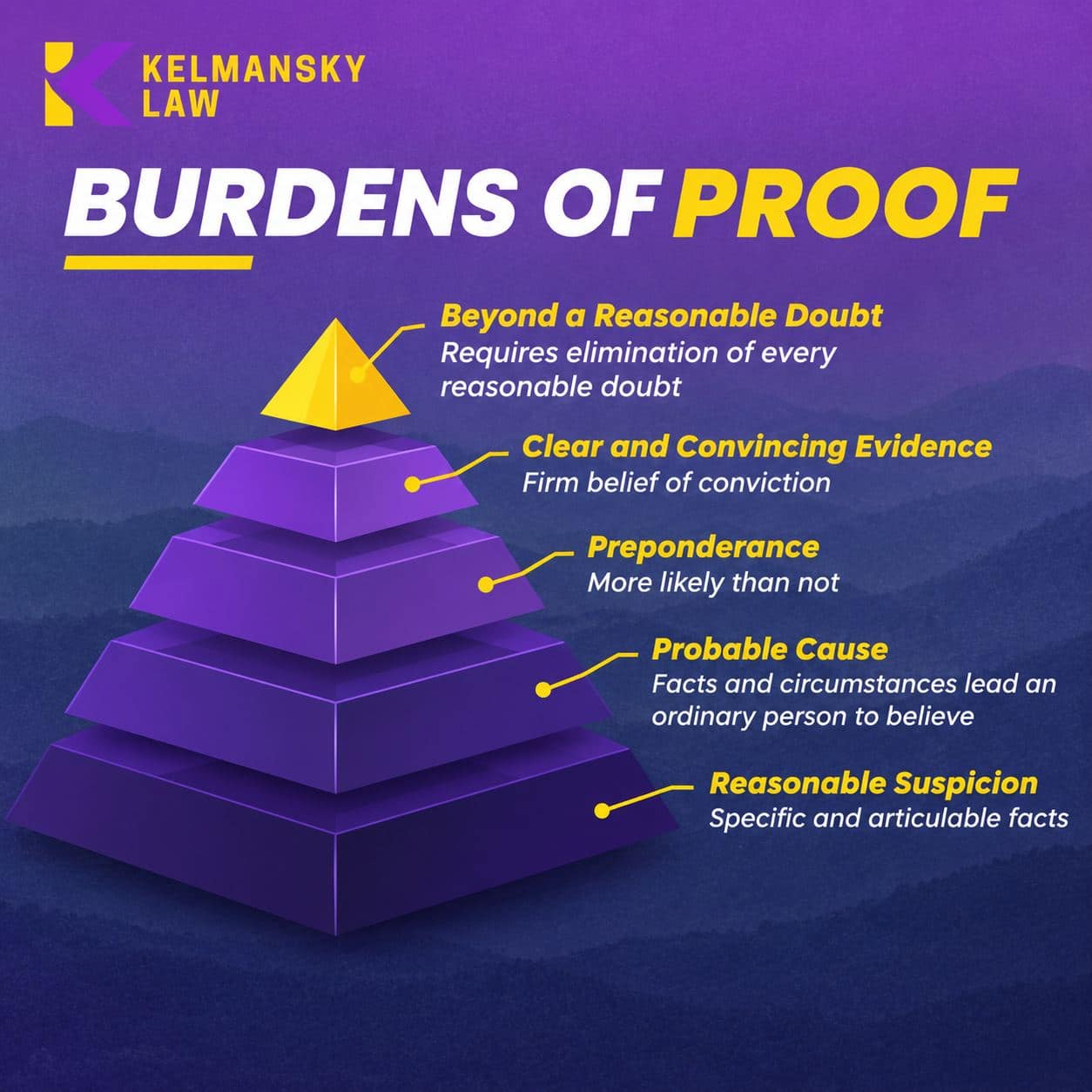
The burden of proof in criminal law consists of two distinct but related components: the burden of production and the burden of persuasion. The burden of production refers to the obligation to present sufficient evidence before the court, while the burden of persuasion refers to the duty to convince the judge or jury to the legally required standard. Both components apply to the prosecution with respect to every element of the offense charged.
Different evidentiary standards apply at various stages of criminal proceedings, not only at trial. For instance, probable cause governs the acquisition of warrants and arrest proceedings, while reasonable suspicion applies to police stops and searches. These standards are less demanding than proof beyond a reasonable doubt, reflecting the different legal consequences attached to each procedural stage.
The presumption of innocence imposes three specific obligations on the state: proving the critical facts of the case to the required level of certainty, bearing the burden of production by presenting actual evidence, and ensuring the jury draws no adverse inference from the defendant's mere presence in court facing charges. Additionally, the prosecution bears the burden of disproving any defense once the defendant has satisfied the evidential burden associated with raising that defense.
What are the two parts of the burden of proof?
Two distinct but related components make up the burden of proof in any criminal proceeding: the burden of production and the burden of persuasion. Each operates independently, yet both must be satisfied for the prosecution to secure a conviction.
Burden of production: Presenting enough evidence
The burden of production refers to a party's obligation to come forward with sufficient evidence to support a particular proposition of fact. In criminal cases, the prosecution must present enough evidence to substantiate each element of the offense before the case can proceed. Satisfying this burden is also referred to as establishing a prima facie case.
A point often overlooked is that determining whether the burden of production has been met is an issue of law, not an issue of fact. Consequently, a judge holds the authority to dismiss a case before it reaches the jury if this burden has not been satisfied. The burden of production may shift several times throughout the course of a trial. For instance, once the prosecution presents its case-in-chief, the burden of production shifts to the defendant, who then has the opportunity to provide evidence rebutting the prosecution's case or supporting an affirmative defense.
Burden of persuasion: Proving a claim to the required standard
The burden of persuasion is the degree of belief a party must produce in the mind of the judge or jury that a particular fact is true. Whereas the burden of production concerns whether evidence exists at all, the burden of persuasion concerns the quality and weight of that evidence against a defined legal standard.
Unlike the burden of production, the burden of persuasion is an issue of fact, not an issue of law. As a result, a judge cannot dismiss a case before it reaches the jury solely for failing to meet this burden. The standard of proof required varies according to the type of proceeding. In civil cases, the standard is typically preponderance of the evidence, meaning the fact in dispute is more likely than not to be true. In criminal cases, the prosecution's burden rises significantly higher, requiring proof beyond reasonable doubt, the most demanding standard applied in any court proceeding.
In practice, the burden of persuasion is often decisive in close cases or cases where evidence is limited, as the party who carries it loses if the evidence remains evenly balanced.
Who has the burden of proof in a criminal case?
The prosecution carries the burden of proof in a criminal case. Specifically, the state must prove every element of the alleged offense that is relevant to the guilt of the person charged. This allocation reflects the foundational legal principle that a defendant enters any criminal proceeding presumed innocent, placing the full weight of establishing guilt on the government rather than on the accused.
The trier of fact, whether a judge or jury, determines at trial whether the prosecution has met its burden. In criminal proceedings, that role almost always falls to a jury, given the constitutional right to a jury trial established under the Sixth Amendment. Because jurors are not legal professionals, the judge provides jury instructions that explain the applicable standard of proof, and these instructions are frequently the basis for appeal when a conviction is challenged.
Note that the defendant holds no burden of proof with respect to the critical facts of the case. The accused does not have to testify, call witnesses, or present any evidence whatsoever. The state must independently overcome the presumption of innocence through evidence strong enough to eliminate reasonable doubt. Furthermore, the jury must not draw any adverse inference from the fact that a defendant is charged and present in court facing those charges.
The prosecution's obligation extends beyond simply proving the offense itself. Once a defendant discharges the evidential burden by raising a defense, the prosecution bears the additional legal burden of disproving that defense beyond a reasonable doubt. This means the prosecution must, in effect, prove both the commission of the offense and the inapplicability of any raised defense, to the same exacting standard.
There is, however, no burden of proof with regard to motive or animus in criminal cases in the United States. The intent surrounding an offense does remain relevant, particularly as an element of certain offenses such as first-degree murder, but motive itself does not constitute an independent element requiring proof beyond reasonable doubt. The prosecution must prove every required legal element, but it is not obligated to establish every conceivable fact beyond that standard.
What does proof beyond a reasonable doubt mean?
Proof beyond a reasonable doubt is the highest evidentiary standard applied in any court of law, required by the Due Process Clauses of the Fifth and Fourteenth Amendments before a person may be convicted of a crime. The Supreme Court expressly established this constitutional requirement in In re Winship (1970), holding that the standard applies to every fact necessary to constitute the offense charged.
The standard does not require absolute certainty. In reality, it requires that the evidence be of such a convincing character that a rational person would not hesitate to rely upon it when making a significant decision. A reasonable doubt is one grounded in reason and common sense after careful and impartial consideration of all evidence presented at trial, not a doubt rooted in speculation or imagination. Doubts that are purely speculative or fanciful do not meet the threshold warranting acquittal; only doubts supported by a coherent basis in the evidence carry legal weight.
The prosecution must prove each individual element of the offense to this standard. If even one element remains unproven beyond reasonable doubt, a conviction cannot lawfully follow. Significantly, when researchers asked judges to assign a numerical value to this standard, the judges placed it between 90 and 95 percent certainty, though courts generally avoid imposing any fixed numerical threshold on jurors.
Compared to the preponderance of evidence standard used in civil proceedings, which requires only a greater than 50 percent probability that a fact is true, the reasonable doubt standard demands far greater conviction on the part of the trier of fact. This distinction reflects the principle, often linked to Blackstone's ratio, that convicting an innocent person represents a graver error than allowing a guilty person to go free.
In England and Wales, courts have moved away from the phrase "beyond reasonable doubt" in favor of directing jurors to be "sure" of the defendant's guilt, following appellate rulings that the traditional formula risked causing juror confusion.
How do defenses affect the burden of proof?
When a defendant raises a defense in a criminal case, the allocation of the burden of proof shifts in ways that depend on the type of defense asserted and the jurisdiction in which the case is tried. An affirmative defense is one in which the defendant introduces evidence that, if credible, negates criminal liability even where the prosecution has proven the charged acts.
Presenting evidence to raise a defense
The defendant must first satisfy the burden of production to properly raise a defense before the court. This requires presenting sufficient credible evidence to bring the defense into question at trial. If the prosecution fails to meet its own burden of proof on the primary charge, the defendant is acquitted without needing to present any defense evidence at all. Once the defendant discharges the evidential burden, the defense becomes a live issue that the trier of fact must consider.
Who must prove or disprove the defense?
Once a defendant raises a defense, the responsibility for proving or disproving it depends on the jurisdiction and the specific defense involved. In some states, the defendant bears only the burden of production, after which the prosecution must disprove the defense to a preponderance of evidence or, in certain states, beyond reasonable doubt. Contrarily, other states require the defendant to satisfy both the burden of production and the burden of persuasion, typically to a preponderance of evidence standard, not beyond reasonable doubt. Due process does not require the prosecution to disprove every affirmative defense, as long as it proves all elements of the offense.
How defense rules vary by jurisdiction
Jurisdictions differ considerably in how they allocate the burden for specific defenses. For self-defense, most states place only the burden of production on the defendant, after which the prosecution must disprove the claim. For the insanity defense, defendants in many jurisdictions must meet both the burden of production and persuasion. For instance, some states require proof of insanity by clear and convincing evidence.
What happens if the prosecution fails to meet its burden?
Failure by the prosecution to meet its burden produces distinct legal consequences depending on when that failure is identified during proceedings. Evidence that falls short of the required standard is classified as insufficient evidence, and courts treat this deficiency as a matter of law rather than a factual dispute.
At the close of the prosecution's case-in-chief, a judge holds the authority to dismiss the charges outright, even before the defense presents its case. This occurs through a motion to dismiss for insufficient evidence, which tests whether the state has produced substantial evidence of each essential element of the offense and identified the defendant as the perpetrator. If the judge allows such a motion, the resulting judgment carries the force and effect of a not guilty verdict. On account of double jeopardy protections, the prosecution cannot retry the defendant on the same charge following a dismissal based on insufficient evidence.
Where the case reaches the jury, any remaining reasonable doubt after deliberation compels a not guilty verdict. Additionally, insufficient evidence serves as grounds for appeal even after a guilty verdict has been returned. Appellate courts may overturn convictions where no rational jury could have found the defendant guilty based on the evidence presented at trial.
References
https://en.wikipedia.org/wiki/Burden_of_proof_(law)
https://en.wikipedia.org/wiki/Reasonable_doubt
https://www.law.cornell.edu/wex/affirmative_defense
https://www.justice.gov/archives/jm/criminal-resource-manual-1732-protection-government-processes-constitutionality-18-usc-1512d
Standards of Proof for ‘Beyond a Reasonable Doubt’ in Criminal Law
To better understand beyond a reasonable doubt, it helps to look at two other standards that courts may apply:
- A preponderance of the evidence. The evidence in a case is convincing that the facts as presented by one party are more likely to be true than not true. In some cases, the standard is held to a greater than 50 percent chance that the facts are true.
- Clear and convincing evidence. While the requirement of clear and convincing evidence there is a high probability that the facts as presented by one party are true. While this seems very similar to the preponderance of evidence requirement, the requirement for clear and convincing evidence is actually a higher standard of proof.
- Beyond a reasonable doubt. This is the highest standard in the American legal system. In a criminal case, because the stakes are so high, it is not enough to prove that the defendant is “probably guilty”. Rather, the prosecution must prove each element of its case beyond a reasonable doubt, and there is literally no other explanation as to what really happened.
Need a Criminal Defense Attorney? CALL NOW: 213-932-8922
Yuliya Kelmansky is an Expert Criminal Defense Attorney who has over 10 years of practice defending a variety of criminal cases.