



Preponderance of Evidence
Preponderance of evidence is an evidentiary standard used in a burden of proof analysis, most commonly applied in civil trials. Under this standard, the burden of proof is met when the party carrying it convinces the fact finder that there is a greater than 50% chance that the claim is true. The definition of preponderance, as established through case law, centers on probability: a contested fact must be considered more probable than its nonexistence for the standard to be satisfied.
The Superior Court of Pennsylvania, in Karch v. Karch (2005), defined it as "the greater weight of the evidence," noting that tipping a scale slightly is the requirement for preponderance to be established. This scale analogy captures the standard accurately. The plaintiff's evidence does not need to be overwhelming; it simply needs to outweigh the opposing evidence, even by a narrow margin. In Barbour v. Municipal Police Officers' Education & Training Commission (2012), the court further held that preponderance of evidence is "such evidence as leads a fact-finder to find a contested fact to be more probable than its nonexistence".
Note that the standard does not hinge on the volume of evidence presented. It refers to the quality and persuasiveness of the evidence, not to the number of witnesses or documents produced. A single, credible piece of testimony can outweigh multiple less persuasive exhibits. In determining whether a fact has been proven by preponderance, the fact finder may consider relevant testimony from all witnesses, all admitted exhibits, and any stipulations entered into by the parties, regardless of which side produced them.
A key condition governs cases where the evidence is evenly balanced: if neither side's evidence is more convincing than the other's, the party bearing the burden of proof has not met it. In other words, a tie does not satisfy the standard. The burdened party must present the more convincing evidence for the claim to succeed.
The term "more likely than not" functions as a practical shorthand for this standard. Proof by information that, compared with information opposing it, leads to the conclusion that the fact at issue is more probably true than not, satisfies the preponderance threshold. This makes it a less demanding standard comparatively to the beyond a reasonable doubt requirement applied in criminal proceedings.
Who has the burden of proof?
In civil cases, the party bringing the claim, called the plaintiff, carries the burden of proof. This means the plaintiff must both produce evidence and persuade the fact finder that their version of events is more likely true than not. The burden of proof is generally understood to consist of two distinct but related components: the burden of production and the burden of persuasion.
The burden of production requires the plaintiff to put forward evidence in the form of witness testimony, documents, or physical objects. Once the plaintiff presents their case-in-chief, the burden of production shifts to the defendant, who then has the opportunity to rebut the plaintiff's evidence or support their own arguments. The burden of persuasion, however, remains with the plaintiff throughout. This component governs the standard of proof the plaintiff must meet when presenting evidence to the judge or jury. Under the preponderance standard, this means convincing the fact finder that there is a greater than 50% chance the claim is true.
Notably, certain circumstances can shift part of the burden to the defendant. Two primary situations apply:
- Affirmative defenses: If the defendant argues comparative negligence, claiming the plaintiff contributed to the harm, the defendant must present evidence supporting that position.
- Presumptions under the law: In some jurisdictions, the law presumes negligence unless the defendant proves otherwise, such as in dog bite cases in Pennsylvania.
These shifts do not relieve the plaintiff of their ultimate burden to establish liability. The plaintiff's obligation to prove each essential element of the claim remains intact regardless of what the defendant asserts.
The burden applies across a wide range of civil proceedings, including personal injury, medical malpractice, product liability, employment disputes, and contract claims. In each context, the plaintiff must present the more convincing evidence on each element of the claim. If the evidence is equally balanced, the plaintiff has not satisfied the burden, and the verdict must favor the defendant.
Judges instruct juries on how to apply this standard at trial. Jurors are directed that if the plaintiff's claims are more likely true than not, they should rule in the plaintiff's favor, and if not, they must find for the defendant.
When is preponderance of evidence used?
Generally preponderance of evidence is not used in criminal courts. It is used in juvenile cases during transfer/waiver hearings.
Civil courts apply the preponderance of evidence standard across a wide range of civil proceedings, making it the most common evidentiary standard in non-criminal legal proceedings. The nature of the case determines which standard applies, with preponderance serving as the baseline for most civil actions filed in court.
Personal injury cases, contract disputes, and other business-related civil actions all operate under this standard. Cases such as slip-and-fall claims, medical malpractice suits, product liability actions, and employment disputes require the plaintiff to demonstrate that the defendant's conduct more probably than not caused the harm alleged. The level of evidence must be sufficient to show that the defendant caused the plaintiff's harm, and no higher threshold applies. Notwithstanding the variety of case types that use this standard, the underlying requirement remains consistent: the plaintiff's version of events must appear more probable than not.
The reason civil courts use this lower standard, compared to criminal proceedings, relates directly to the consequences at stake. Civil cases result in monetary damages or injunctive relief, not prison time. Because the defendant's liberty is not at risk, the law does not require the same degree of certainty demanded in criminal trials. This allows both the plaintiff and defendant a fair opportunity to litigate disputes without the extraordinary evidentiary burden that criminal courts impose.
Not all civil cases, however, rely on preponderance. Certain civil matters require the higher standard of clear and convincing evidence, which sits above preponderance but below the criminal standard of beyond a reasonable doubt. The distinction between these two civil standards is determined by the type of claim. For the most part, clear and convincing evidence applies where the consequences of an adverse finding are particularly serious, such as in fraud cases, civil commitment proceedings, or actions to terminate parental rights. Different jurisdictions may additionally impose their own requirements regarding the nature and form of evidence presented, meaning the specific application of the standard can vary by location. What remains fixed across jurisdictions is that preponderance of evidence governs the majority of civil cases filed, making it the foundational standard through which civil liability is established.
How do judges and juries weigh the evidence?
Judges and juries, collectively referred to as triers of fact, evaluate evidence not by counting how many pieces support each side, but by assessing the persuasiveness and believability of what is presented. Weight of the evidence refers to the degree to which credible evidence convinces the trier of fact to accept or reject a factual assertion. This applies both to a single piece of evidence and to the cumulative effect of all evidence presented on a given issue.
The definition of preponderance itself reinforces this principle: the standard is determined by the quality and persuasiveness of evidence, not the number of witnesses or documents produced. A single credible witness may outweigh multiple less reliable exhibits. Inasmuch as the fact finder must assess reliability, testimony from individuals with first-hand knowledge carries considerably more weight than accounts from those relying on secondhand information.
Before evidence can be weighed at all, it must first be authenticated and admitted. Courts require that tangible or documentary evidence meet authentication standards, confirming the item is what the proponent claims it to be. Beyond authentication, the court evaluates relevance, hearsay rules, and whether the probative value of the evidence is substantially outweighed by the danger of unfair prejudice or confusion of the issues. Only evidence that clears these admissibility requirements reaches the trier of fact for weighing.
Once admitted, the fact finder considers relevant testimony from all witnesses regardless of which party called them, all admitted exhibits regardless of who produced them, and any stipulations the parties have entered into. Notably, if the plaintiff's evidence and the defendant's evidence are equally balanced, the party bearing the burden of proof has not satisfied it. The evidence must tip the scale, however slightly, in the burdened party's favor. As established in Karch v. Karch, "to tip a scale slightly is the criteria or requirement for preponderance of the evidence". The court's role during this process includes exercising control over the presentation of evidence to ensure an effective, fair, and efficient proceeding, with the ultimate determination of persuasiveness left to the trier of fact.
Examples of preponderance of evidence
Two areas of civil litigation most frequently illustrate how the standard operates in practice: motor vehicle accident claims and breach of contract disputes.
Proving fault in a car accident claim
In a car accident claim, the plaintiff must prove the defendant's fault by a preponderance of the evidence, meaning it was more likely than not that the defendant principally caused the accident. The plaintiff establishes this by demonstrating four elements of negligence: duty of care, breach of that duty, causation, and damages. A driver, for instance, owes all others on the road a duty to operate their vehicle with reasonable care. If that driver runs a red light and causes a collision, the plaintiff must show that this breach directly caused the accident and the resulting injuries.
Evidence used to establish fault includes police reports, eyewitness testimony, photographs of vehicle damage, surveillance footage, medical records, and expert testimony. Where two drivers present conflicting accounts, namely a "he said, she said" scenario, an independent eyewitness or a police report corroborating the plaintiff's account can tip the evidentiary scale in the plaintiff's favor.
Proving a breach of contract
A breach of contract claim likewise requires the plaintiff to satisfy the preponderance standard by proving four distinct elements:
- A valid contract existed between the parties
- The plaintiff performed their obligations under the contract
- The defendant failed to perform their obligations
- The plaintiff sustained damages as a result of that failure
For a valid contract to exist, there must be an offer, acceptance, and consideration, i.e., each party must receive or forgo something of value. Evidence such as signed agreements, invoices, delivery records, payment confirmations, and written communications between the parties supports each element. If the plaintiff fails to prove even one element, the entire claim fails, due to the requirement that every element be established by a preponderance of the evidence.
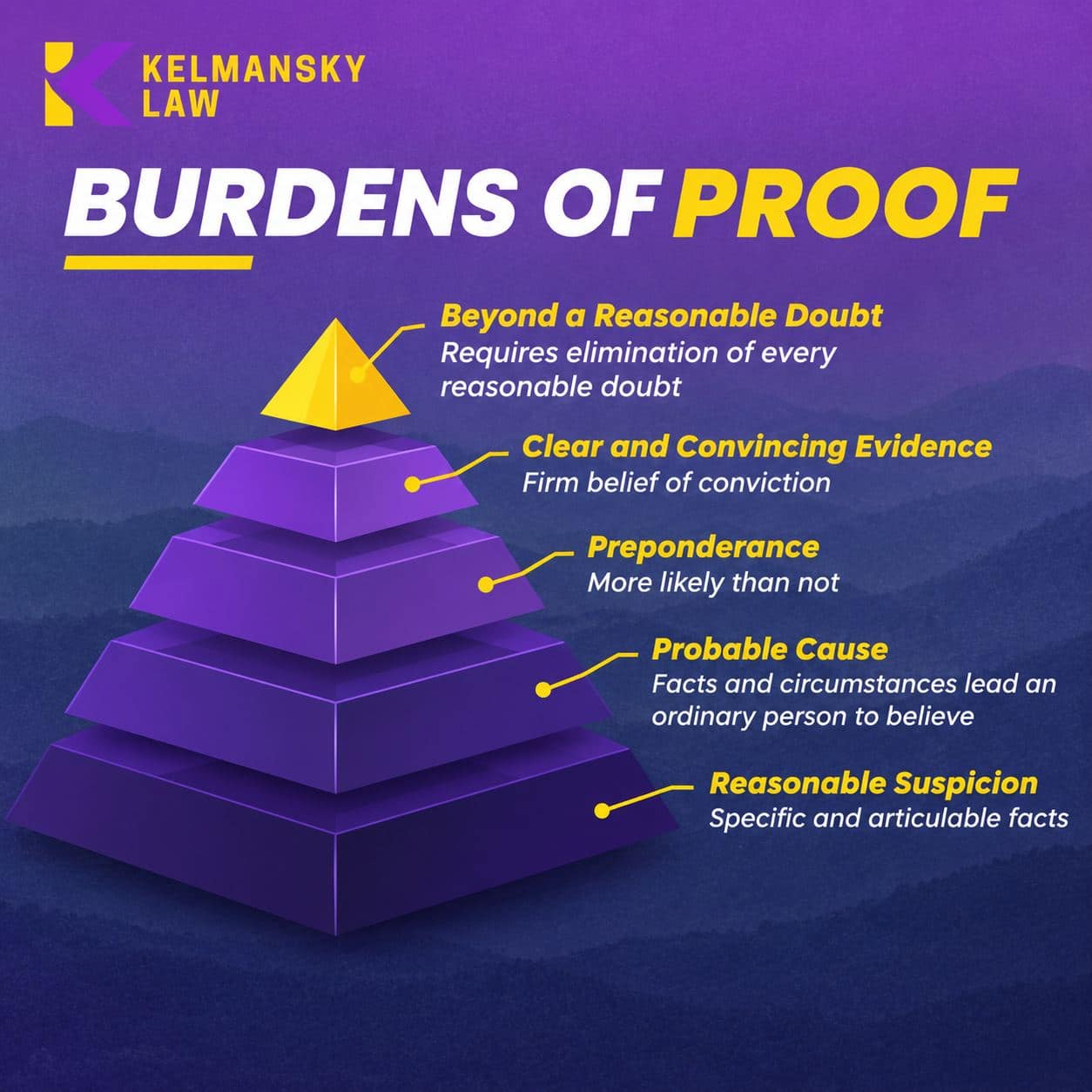
How does preponderance of evidence compare with other standards?
Three distinct evidentiary standards govern legal proceedings, each calibrated to the severity of the consequences at stake.
Preponderance of evidence: More likely true than not
This standard sits at the lowest threshold among the three, requiring that a claim be more probable than not. Empirical research places it at approximately 54.4% certainty. It applies in most civil proceedings where monetary damages, rather than liberty, are at stake.
Clear and convincing evidence: Highly likely to be true
Clear and convincing evidence is an intermediate standard, specifically requiring that a fact be substantially more likely true than untrue, as defined by the Supreme Court in Colorado v. New Mexico, 467 U.S. 310 (1984). Notably, it carries no fixed percentage, though judicial quantification places it at roughly 73.4%. This standard applies in civil matters involving fraud, termination of parental rights, and withdrawal of life support.
Beyond a reasonable doubt: The standard for proving criminal guilt
Beyond a reasonable doubt is the highest burden of proof in law, averaging approximately 90.1% certainty. The prosecution must leave jurors firmly convinced of guilt, with no logical alternative explanation derivable from the facts. It applies exclusively in criminal proceedings, where a defendant's liberty is directly at risk.
References
https://www.vtd.uscourts.gov/sites/vtd/files/BURDEN%20OF%20PROOF%20-%20PREPONDERANCE%20OF%20EVIDENCE.pdf
https://www.findlaw.com/litigation/filing-a-lawsuit/standards-of-proof-in-civil-cases-preponderance-of-evidence-and-clear-and-convincing-evidence.html
https://www.justia.com/trials-litigation/lawsuits-and-the-court-process/evidentiary-standards-and-burdens-of-proof/
https://www.law.cornell.edu/wex/weight_of_the_evidence
https://judges.org/news-and-info/judicial-news-judicial-edge-federal-rules-of-evidence/
https://judicature.duke.edu/articles/legal-standards-by-the-numbers/
https://www.law.cornell.edu/wex/clear_and_convincing_evidence
https://www.law.cornell.edu/wex/beyond_a_reasonable_doubt
We’re Here to Help
Are you under police investigation, or have been arrested in the greater Los Angeles area? We cannot stress enough the importance of consulting and retaining a lawyer to protect your rights, privacy and future.
Need a Criminal Defense Attorney? CALL NOW: 213-932-8922
Yuliya Kelmansky is an Expert Criminal Defense Attorney who has over 10 years of practice defending a variety of criminal cases.