

What Is Probable Cause in Criminal Law?
Understanding the Legal Standard
Probable cause is a legal standard that California police generally must meet before making an arrest, conducting a search, or obtaining a warrant. It comes from the Fourth Amendment of the U.S. Constitution and Article I, Section 13 of the California Constitution. Both provisions contain nearly identical language.
Probable cause exists when the facts known to an officer would lead a reasonable person to believe that a crime occurred or that evidence of a crime exists in a specific place. Neither constitution defines the term. Courts have developed its meaning through case law.
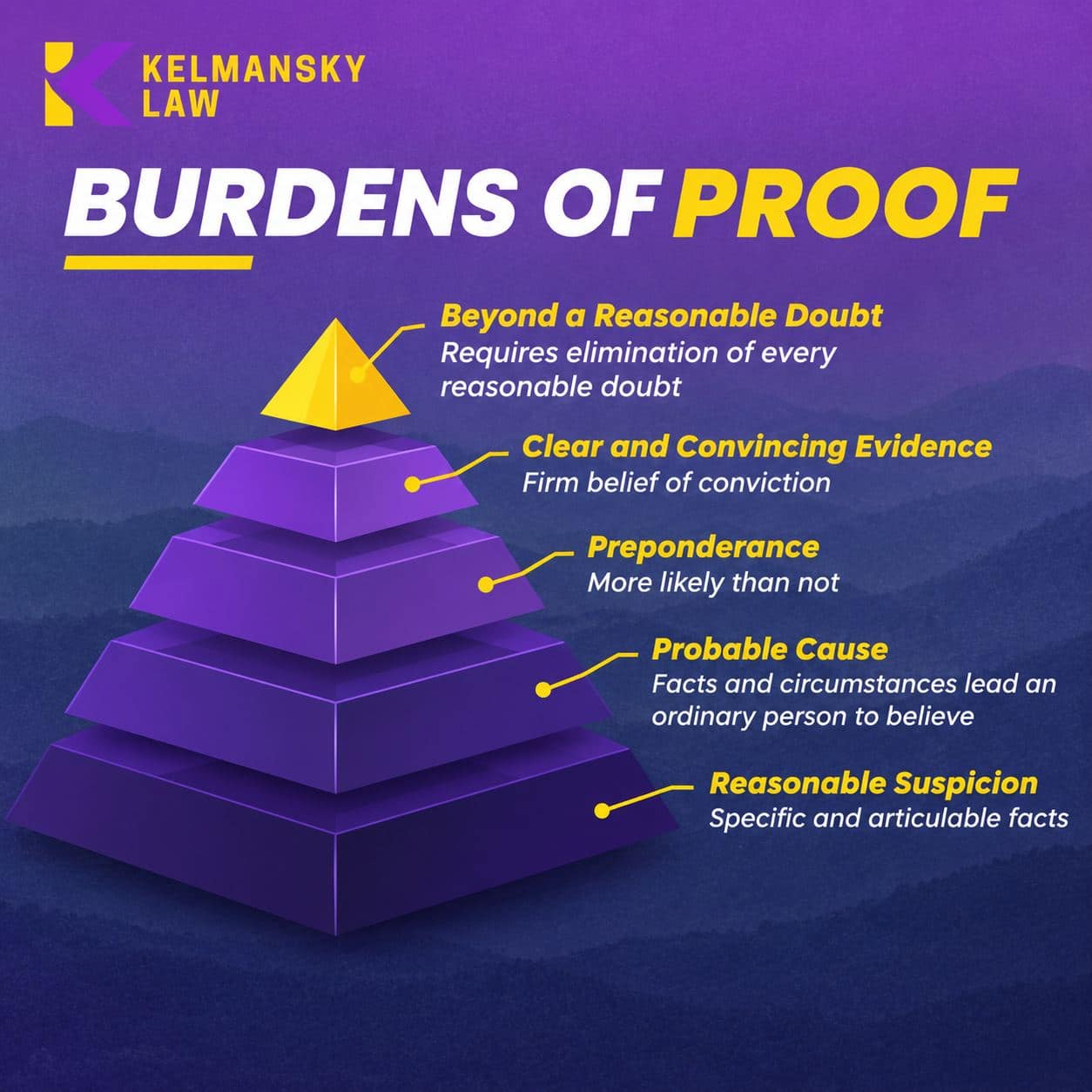
The standard requires more than a mere suspicion, but it does not require absolute certainty. Courts describe probable cause as a “fair probability” that criminal activity or evidence will be found. It does not require proof beyond a reasonable doubt.
Probable cause also requires less evidence than a conviction or a finding based on a preponderance of the evidence. Reasonable suspicion allows only limited investigative stops. Probable cause requires a higher level of certainty before police may arrest someone or intrude on property.
The Totality of the Circumstances Test
The U.S. Supreme Court shaped the modern meaning of probable cause in Illinois v. Gates, 462 U.S. 213 (1983). The Court established the “totality of the circumstances” test, which California courts also apply.
Under this test, courts review all available facts together. They do not rely on rigid or technical rules. The Court described probable cause as a “practical, non-technical” concept.
Courts also give weight to a magistrate’s decision to issue a warrant. They do so when a substantial basis supports the finding of probable cause.
When Probable Cause Applies
California officers generally need probable cause before searching a person or property. They also need it before making an arrest.
California courts must also find probable cause before a defendant proceeds to trial. For felony cases, this usually happens at a preliminary hearing or through a grand jury indictment (Penal Code sections 859b and 872).
Probable cause applies to arrests, searches, seizures, and warrants. It serves as a key constitutional protection against unreasonable government intrusion into people’s lives, homes, and businesses.
Why Is Probable Cause Important Under California and Federal Law?
Constitutional Protections
The Fourth Amendment states that “no Warrants shall issue, but upon probable cause, supported by Oath or affirmation, and particularly describing the place to be searched, and the persons or things to be seized.”
Article I, Section 13 of the California Constitution includes a similar requirement for California law enforcement. Penal Code section 1525 also requires probable cause before a magistrate may issue a search warrant.
The warrant must include a supporting affidavit. It must name or describe the person or place to be searched. It must also describe the property and location that officers seek to search.
The Role of a Neutral Magistrate
Searches and seizures without prior judicial approval are generally presumed unreasonable. A neutral and detached magistrate—not a law enforcement officer—must usually decide whether probable cause exists.
This rule prevents police from relying only on their own judgment when they seek to search or seize property. Justice Robert H. Jackson discussed this protection in Johnson v. United States (1948).
The Fourth Amendment requires a neutral magistrate to draw the necessary inferences. It does not allow an officer who investigates a crime to make every decision about whether a search should occur.
Balancing Privacy and Public Safety
Courts consider two interests when they review a search or seizure. The first is a person’s privacy and security. The second is the government’s interest in public safety and preserving evidence.
Probable cause helps courts decide when the government’s interest justifies an intrusion on a person’s rights.
The Exclusionary Rule in California
The exclusionary rule helps enforce these constitutional protections. However, California has a special rule that affects when courts may suppress evidence.
In 1982, voters approved Proposition 8, also known as the “Truth-in-Evidence” provision (Cal. Const., art. I, section 28(f)(2)). It generally prevents California courts from excluding relevant evidence based only on state law.
As a result, California courts suppress evidence when federal law, including the Fourth Amendment, requires it. The California Supreme Court confirmed this rule in In re Lance W. (1985) 37 Cal.3d 873.
Later cases, including People v. Camacho (2000) 23 Cal.4th 824, treat California search-and-seizure law as consistent with the federal Fourth Amendment.
When federal law requires suppression, the rule may also apply to the “fruit of the poisonous tree“. This term refers to evidence that police discover as a result of an unconstitutional search.
Exceptions to the Warrant Requirement
Some exceptions allow police to search without first obtaining a warrant. These include consent, searches incident to a lawful arrest, plain view, and exigent circumstances.
These exceptions are limited. Even when exigent circumstances allow a warrantless search, police must still have probable cause. The exception removes the warrant requirement, not the underlying legal standard.
How Does Probable Cause Differ From Reasonable Suspicion in California?
What Is Reasonable Suspicion?
Reasonable suspicion is a lower standard than probable cause. It requires specific facts that would lead a reasonable officer to believe that criminal activity may be happening.
The U.S. Supreme Court established this standard in Terry v. Ohio, 392 U.S. 1 (1968). The California Supreme Court applied the same concept in In re Tony C. (1978) 21 Cal.3d 888.
Under these cases, an officer must rely on specific, explainable facts to detain someone. Penal Code section 833.5 also addresses detention and frisk standards in certain firearm and weapon-related situations.
What Police Can Do With Reasonable Suspicion
Reasonable suspicion allows limited police action. Under Terry, an officer may conduct a brief investigative stop.
If the officer reasonably believes that the person is armed and dangerous, the officer may also perform a limited pat-down of the person’s outer clothing. This frisk serves officer safety. It does not allow the officer to search for evidence.
Reasonable suspicion does not authorize a full search of a person, vehicle, or property. It also does not support an arrest or a search warrant.
How Probable Cause Differs
Probable cause requires a higher level of certainty. It exists when the facts would lead a reasonable person to believe that a crime has been, is being, or is about to be committed.
This standard requires more than the possibility of criminal activity. It can support an arrest, a search, or the issuance of a warrant.
How a Police Encounter May Develop
Reasonable suspicion often arises first during a police encounter. It may justify an investigative stop.
As officers gather more information, the facts may support probable cause. For example, officers may observe signs of intoxication or receive admissions from a suspect. If the evidence reaches the probable cause standard, officers may make an arrest.
A person’s refusal to cooperate during a consensual encounter does not, by itself, establish probable cause. The U.S. Supreme Court discussed this principle in Florida v. Bostick, 501 U.S. 429 (1991).
California’s Cannabis Law
California law also limits what officers may rely on when investigating lawful cannabis activity.
Under Health and Safety Code section 11362.1(c), conduct that adults may legally engage in under California’s cannabis law cannot, by itself, justify a detention, search, or arrest.
Officers must have facts that point to something beyond lawful cannabis activity. One example is evidence of impairment while driving.
How Is Probable Cause Established in California?
California officers establish probable cause through facts, observations, and information available at the time of a stop, search, or arrest.
Courts evaluate what officers knew at that moment. They do not base the decision on evidence that officers discovered later.
Facts Known to Police at the Time
An officer’s direct observations often provide a clear basis for probable cause. Physical evidence, witnessed conduct, and signs of intoxication may all point to criminal activity.
An officer’s training and experience may also help explain those observations. However, the officer must still rely on specific facts.
A supporting affidavit presented to a California magistrate must describe those facts. It cannot rely only on general or conclusory statements. Penal Code section 1527 requires the affidavit to be sworn and to state facts that support the grounds for the warrant.
Witness Reports and Reliable Tips
Information from victims or witnesses may help establish probable cause. When police rely on an informant, the informant’s reliability becomes important.
In Aguilar v. Texas, the U.S. Supreme Court required courts to consider the informant’s basis of knowledge and veracity.
An anonymous tip alone generally does not establish probable cause. However, independent police work may confirm the tip and strengthen its reliability. The Court considered this approach in Draper v. United States.
California courts apply these federal principles along with the totality-of-the-circumstances test.
Looking at All the Facts Together
In Illinois v. Gates, the U.S. Supreme Court replaced rigid two-part testing with the totality of the circumstances approach.
A magistrate or officer considers the complete picture rather than evaluating each fact separately. A weakness in one area, such as an informant’s reliability, may be offset by strong evidence in another area.
For example, a detailed tip that police independently confirm may carry more weight than an unsupported anonymous report.
When Do California Police Need Probable Cause?
California police generally need probable cause before making an arrest, conducting a search, or obtaining a warrant from a judge.
Probable Cause for Arrests
A valid arrest must have probable cause, whether police make it with or without a warrant.
Under Penal Code section 836, an officer may make a warrantless arrest when probable cause supports the belief that a person committed a felony. The felony does not have to occur in the officer’s presence.
For misdemeanors, the general rule requires the offense to occur in the officer’s presence. California law creates several exceptions, including certain domestic violence offenses and some traffic and weapons offenses.
Probable cause for an arrest is not the same as guilt. Police may have probable cause even if a court later finds the person not guilty.
Judicial Review After a Warrantless Arrest
An arrest warrant reflects a judge’s finding of probable cause (Penal Code sections 813 and 817).
For a warrantless arrest, a judge must review the arrest promptly. Under County of Riverside v. McLaughlin, 500 U.S. 44 (1991), a probable cause determination within 48 hours is generally presumed prompt.
Penal Code section 825 requires California officers to bring an arrestee before a magistrate without unnecessary delay. This generally means within 48 hours.
If probable cause is lacking, authorities cannot continue to hold the person. Under Penal Code section 849, officers must release an arrestee when insufficient grounds exist for a criminal complaint.
Probable Cause for Searches and Search Warrants
For a search, probable cause exists when a fair probability suggests that the search will uncover evidence of a crime at a specific location.
Under Penal Code section 1524, a California magistrate may issue a search warrant only for the grounds listed in the statute. These include property that was stolen or embezzled, property used to commit a felony, or property that may show a felony occurred.
The warrant must have a sworn affidavit (Penal Code sections 1525 and 1527). It must also describe the place and items that officers may search or seize.
Officers generally must execute the warrant within 10 days of its issuance (Penal Code section 1534). They may not search areas or seize items beyond the warrant’s terms.
California also allows telephonic and electronic warrant procedures under Penal Code section 1526.
The Automobile Exception
Under the automobile exception, police may search a readily mobile vehicle without a warrant when probable cause supports the belief that it contains evidence or contraband.
Searches of Digital Information
California provides special protection for digital information.
Under the California Electronic Communications Privacy Act (CalECPA, Penal Code section 1546 and following), government entities generally need a warrant to compel the production of electronic communication information or access electronic device data.
The law includes limited exceptions to this warrant requirement.
What Happens if California Police Lack Probable Cause?
Suppressing Evidence
A warrantless arrest or search without probable cause may violate the Fourth Amendment and Article I, Section 13 of the California Constitution.
The primary remedy is the exclusionary rule, which the U.S. Supreme Court established in Mapp v. Ohio, 367 U.S. 643 (1961).
This rule prevents the government from using unconstitutionally obtained evidence at trial. It may also apply to the “fruit of the poisonous tree,” which refers to evidence discovered as a result of an unlawful search.
Because of Proposition 8, California courts suppress evidence only when federal constitutional law requires them to do so.
Filing a Motion to Suppress
In California, a defendant may seek to suppress evidence through a motion under Penal Code section 1538.5.
The defendant may file the motion at the preliminary hearing and renew it in superior court. The defendant may also seek appellate review of a denied motion, even after entering a guilty plea.
A defendant may challenge the sufficiency of the evidence presented at the preliminary hearing through a motion under Penal Code section 995.
Other Possible Remedies
Beyond suppression, an unlawful arrest may lead to release from custody. Under Penal Code section 851.8, a person may also petition to have the arrest sealed and declared a detention only. This remedy may apply based on factual innocence or a lack of reasonable cause.
The person may also bring a civil lawsuit. Officers acting under color of state law may face a federal lawsuit under 42 U.S.C. section 1983.
California’s Tom Bane Civil Rights Act (Civil Code section 52.1) also provides civil remedies when threats, intimidation, or coercion interfere with a person’s rights.
The Good-Faith Exception
A narrow good-faith exception may apply when officers reasonably rely on a warrant or an erroneous court record.
Under Arizona v. Evans, 514 U.S. 1 (1995), and United States v. Leon, 468 U.S. 897 (1984), courts need not exclude evidence when officers relied on the warrant or record in an objectively reasonable way.
California courts apply these federal good-faith principles. One example is People v. Willis (2002) 28 Cal.4th 22.
Conclusion
Probable cause is a key protection under the Fourth Amendment and Article I, Section 13 of the California Constitution. It sets the legal standard for arrests, searches, and warrants in California.
It requires more than reasonable suspicion, but it does not demand proof beyond a reasonable doubt. Proposition 8 also limits when California courts may suppress evidence.
Understanding how police establish probable cause, how it differs from reasonable suspicion, and what happens when police lack it can help anyone facing a California criminal case.
The facts and legal standards in each case may differ. Consulting an experienced California criminal defense attorney can help determine whether probable cause existed, identify possible Fourth Amendment violations, and protect your rights throughout the legal process.
Contact an experienced California criminal defense attorney to discuss your case and learn about your legal options.
RELATED ARTICLE:
Need an Attorney? CALL NOW: 213-932-8922
Yuliya Kelmansky is an Expert Attorney who has over 10 years of practice defending a variety of cases.