






What is clear and convincing evidence?
Clear and convincing evidence is a standard of proof used in some legal cases. It requires a party to show that a claim is highly likely to be true. This standard falls between preponderance of the evidence, which applies in many civil cases, and proof beyond a reasonable doubt, which applies in criminal cases. It does not require absolute certainty. But it requires more than a slight chance that a claim is true.
The U.S. Supreme Court described this standard in Colorado v. New Mexico, 467 U.S. 310 (1984). The evidence must make a claim “highly and substantially more likely to be true than untrue.” The trier of fact—a judge or jury—must reach a firm belief that the claim is highly probable. California’s Civil Jury Instruction CACI No. 201 explains that the party must persuade the jury that the fact is “highly probable.”
Courts use this standard in both civil and criminal proceedings, though it appears most often in civil cases involving important rights or interests. Judges and juries weigh the quality of the evidence as well as its amount. They consider whether witnesses seem credible and whether the evidence seems reliable. A large amount of weak or unreliable evidence may not meet the standard.
Some cases require clear and convincing evidence because of the serious consequences at stake. Examples include fraud claims, will disputes, decisions to withdraw life support, and involuntary hospitalization. The standard may also apply to some affirmative defenses, where a defendant accepts the basic facts but seeks to justify their conduct. The claims that require this standard vary by jurisdiction and type of case. In California, for example, the law requires clear and convincing evidence for certain findings in cases involving termination of parental rights and punitive damages.
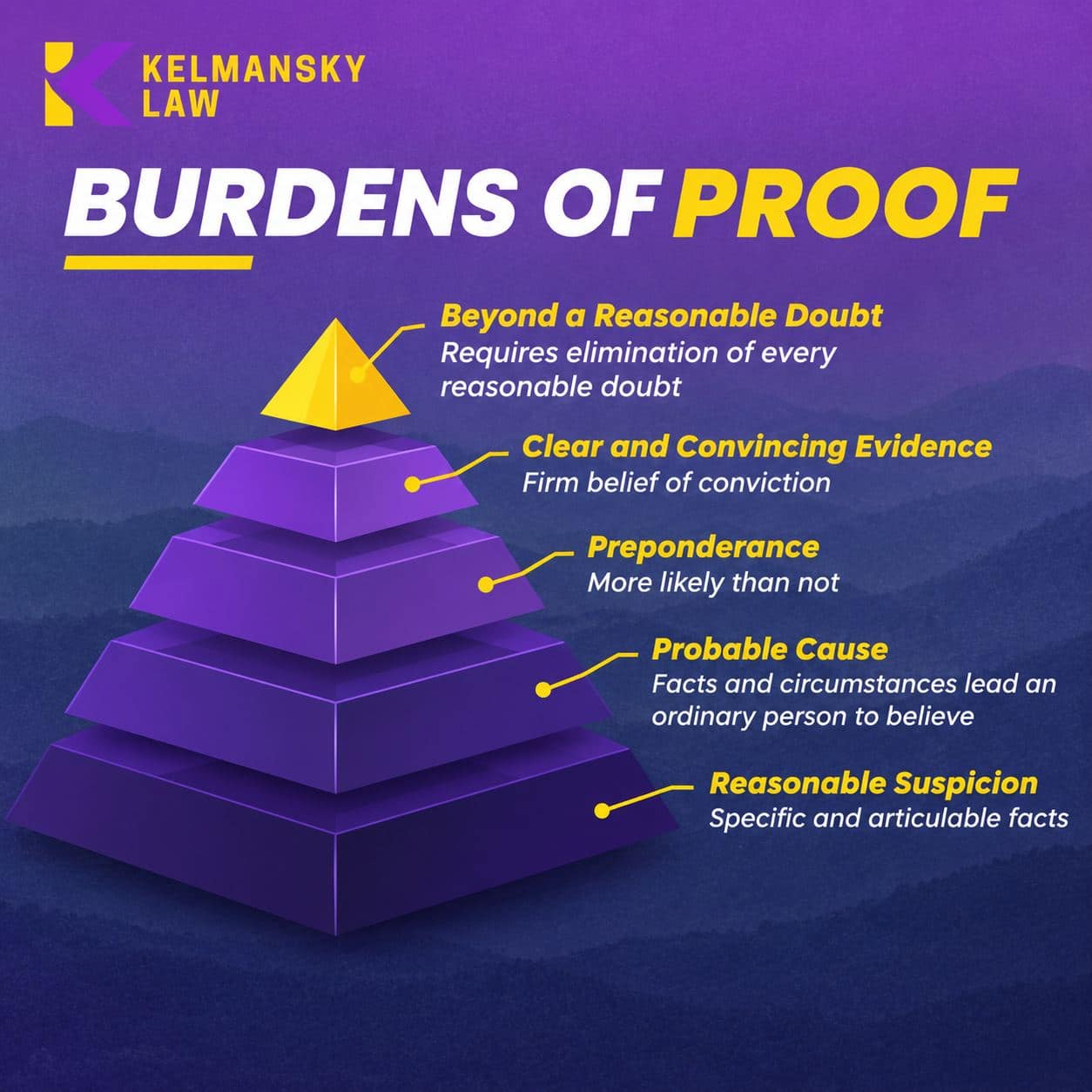
How does clear and convincing evidence compare with other standards of proof?
U.S. courts use different standards of proof for different legal proceedings. The consequences at stake often affect which standard applies. Clear and convincing evidence sits between the standard used in many civil cases and the standard used in criminal prosecutions.
Clear and convincing evidence vs. preponderance of the evidence
Preponderance of the evidence is the standard courts use in many civil cases. A party must show that a claim is more likely true than not. Courts often describe this as a 51% probability. Personal injury cases, contract disputes, and other civil actions commonly use this standard. The evidence meets the standard if it tips the balance, even slightly, in one party’s favor.
Clear and convincing evidence requires more. The evidence must make the claim substantially more likely to be true than false. The judge or jury must have a firm belief in the claim. Courts also consider the quality of the evidence, including witness credibility and reliability. A large amount of weak or conflicting evidence may still fall short.
Clear and convincing evidence vs. beyond a reasonable doubt
Proof beyond a reasonable doubt is the highest standard described here. It applies mainly in criminal cases. The U.S. Constitution requires the government to meet this standard before a court can convict a defendant. The Supreme Court established this rule in In re Winship, 397 U.S. 358 (1970). Courts describe this level of certainty as moral certainty. Any remaining doubt must be unreasonable, rather than based on logic or evidence.
This standard requires the evidence to leave no reasonable alternative explanation for the defendant’s guilt. The prosecution bears this high burden because criminal penalties may include imprisonment or loss of life. Clear and convincing evidence requires a high probability, but it does not demand the same level of certainty.
When is clear and convincing evidence required?
Some legal proceedings require clear and convincing evidence because an incorrect ruling could have serious or lasting effects. These cases may involve family relationships, personal liberty, or financial penalties. The law may therefore require stronger proof than it does in ordinary civil disputes.
Termination of parental rights in California
In Santosky v. Kramer, 455 U.S. 745 (1982), the U.S. Supreme Court held that clear and convincing evidence is the constitutional minimum standard for terminating parental rights. The Court found that the importance of family unity and the risk of an incorrect decision called for more than a preponderance of the evidence.
Under California Welfare and Institutions Code § 366.26, a court must find by clear and convincing evidence that a child is likely to be adopted before it may terminate parental rights and order adoption. The statute also provides for exceptions that can affect the court’s decision.
Civil commitment and conservatorship in California
Civil commitment means court-ordered treatment or hospitalization under legal authority. The required proof depends on the type of proceeding. In California, the Lanterman-Petris-Short Act provides for conservatorships for people found to have a “grave disability.” A court or jury deciding whether a person is gravely disabled must apply the clear and convincing evidence standard.
California’s Welfare and Institutions Code §§ 5350 and 5352 address LPS conservatorships. These proceedings concern whether a person meets the legal criteria for conservatorship. They do not mean that every mental-health hold or hospitalization in California requires clear and convincing evidence.
Punitive damages under California law
California Civil Code § 3294 requires clear and convincing evidence of oppression, fraud, or malice to support punitive damages in an action for breach of an obligation that does not arise from contract. The law also sets conditions for holding an employer responsible for punitive damages based on an employee’s conduct. For a corporate employer, certain findings must involve an officer, director, or managing agent.
Who has the burden of proving clear and convincing evidence?
The party making a claim usually bears the burden of proof. In a civil case, that party is often the plaintiff. In a criminal case, the prosecution must prove the charges. This principle reflects the Latin phrase semper necessitas probandi incumbit ei qui agit: “the necessity of proof always lies with the person who lays charges.”
The burden of proof has two parts: the burden of production and the burden of persuasion. The burden of production requires a party to present enough evidence to support a legally recognized claim. If the party fails to do so, a judge may dismiss the claim before trial. If the case proceeds, the burden of persuasion requires that party to present evidence that meets the required standard. Together, these duties make up the burden of proof.
A party who must prove a claim or defense by clear and convincing evidence must present proof that creates a firm belief that the facts are highly likely to be true. This higher standard places more of the risk of an incorrect decision on the party with the burden than the preponderance standard does.
Burden shifting can occur with affirmative defenses. A defendant may accept the underlying facts but argue that those facts justify their conduct. In that case, the defendant may have to present evidence to support the defense. Depending on the defense and the jurisdiction, the defendant may need to meet the clear and convincing evidence standard.
How do judges and juries decide whether the standard is met?
Judges and juries consider both the amount and the quality of the evidence. They assess witness credibility, the reliability of exhibits, and whether the evidence fits together. Quantity alone does not meet the standard.
In Colorado v. New Mexico, the U.S. Supreme Court said the trier of fact must have an “abiding conviction” that the claim is “highly probable.” The fact finder must reach a firm belief, not just decide that one side has slightly stronger evidence. Findings must rest on probabilities, not possibilities. Judges and juries cannot guess about disputed facts.
California’s CACI No. 201 tells jurors that clear and convincing evidence means the party must persuade them that the fact is “highly probable.” The instruction does not require jurors to find that the evidence leaves “no substantial doubt.”
Courts evaluate expert testimony like other evidence. Juries may accept or reject some or all of it. They decide how much weight it deserves based on the expert’s qualifications and reasoning. Direct and circumstantial evidence can both help meet the standard. Neither type has a different legal effect.
What is an example of clear and convincing evidence?
Fraud cases offer common examples of this standard. A handwriting expert may verify a defendant’s signature on a document. That evidence may help show that the defendant signed it and knew its contents at the time. An authenticated audio recording in which someone admits to fraud may also strongly support the claim. The judge or jury still weighs the evidence in context.
Patent infringement cases can involve detailed technical evidence. Such evidence may show that a product uses the same or similar technology as a patented product and performs the same function. The proof must persuade the trier of fact that the claim is highly probable. A plausible inference alone may not be enough.
California provides another example in punitive-damages cases. A plaintiff seeking punitive damages under Civil Code § 3294 must prove by clear and convincing evidence that the defendant acted with oppression, fraud, or malice. The court considers the evidence and the legal requirements for the claim.
Conclusion
Clear and convincing evidence requires more proof than a simple balance of probabilities, but less than proof beyond a reasonable doubt. California law uses this standard in certain proceedings, including some parental-rights cases and claims for punitive damages. Judges and juries look at the strength, reliability, and consistency of the evidence as a whole. The standard applies only when the law requires it, and the specific rules depend on the type of case. Anyone involved in a California legal matter can ask a qualified attorney how this standard may affect their case.
RELATED ARTICLE:

Need an Attorney? CALL NOW: 213-932-8922
Yuliya Kelmansky is an Expert Attorney who has over 10 years of practice defending a variety of cases.



