


Prostitution with Drug Offenses in LA
A prostitution sentence takes on new complexity when prosecutors combine it with drug-related charges. These cases frequently occur together in Los Angeles, particularly when law enforcement encounters individuals in situations involving both alleged solicitation and controlled substances. The legal consequences escalate significantly when facing multiple charges simultaneously, affecting everything from potential jail time to plea bargaining opportunities. Understanding how these charges interact, the sentencing guidelines that apply, and your defense options is essential for anyone navigating this challenging legal situation.
Understanding Prostitution Charges in Los Angeles
Legal Definition of Prostitution in California
California Penal Code 647(b) prohibits three distinct acts: engaging in prostitution, soliciting prostitution, and agreeing to engage in prostitution. Prostitution occurs when someone willfully engages in sexual intercourse or a lewd act with another person in exchange for money or other compensation. The law defines "willfully" as acting purposefully, without requiring specific intent to break the law [3].
A lewd act means touching the genitals, buttocks, or female breast of either person involved for sexual arousal or gratification. The exchange doesn't need to involve cash. Compensation can include drugs, housing, or anything of value. Both parties to the transaction face charges under the same statute, whether you're the provider or the customer.
Solicitation requires requesting another person to engage in prostitution with clear intent to follow through. The request must be received by the other person. Simply accepting an offer isn't enough for a conviction. Prosecutors must prove you took an overt act beyond mere agreement. These acts include handing over payment, withdrawing money from an ATM, driving to the agreed location, or instructing someone to undress [3].
Common Prostitution-Related Offenses
Several related charges often accompany prostitution cases. Loitering with intent to commit prostitution under Penal Code 653.22 makes it illegal to delay in public places for purposes of soliciting, even when no specific act occurs. Circumstances indicating intent include repeatedly beckoning to pedestrians, stopping vehicles, or circling an area in a car.
Supervising or aiding a prostitute under Penal Code 653.23 targets those who direct, recruit, or assist others in prostitution activities, or collect proceeds from someone else's prostitution. Pimping under Penal Code 266h involves knowingly deriving support from prostitution earnings. Unlike prostitution itself, pimping is a felony carrying significantly harsher penalties [3].
Pandering under Penal Code 266i criminalizes procuring someone for prostitution, influencing them through promises or intimidation, or receiving compensation for these activities. Human trafficking under Penal Code 236.1 addresses unlawful trade in persons for commercial sexual exploitation.
How Prosecutors Approach These Cases
Prosecutorial strategies vary dramatically depending on courthouse location within Los Angeles County. The Los Angeles City Attorney handles cases differently across courthouses. At the East Los Angeles Courthouse, defendants may qualify for a one-day diversion program requiring them to stay out of trouble for one year before dismissal. Note that this option isn't available for everyone and may create issues for those facing immigration or licensing concerns.
Cases at Airport Courthouse or Van Nuys Courthouse receive far more aggressive prosecution. The same City Attorney's Office that offers diversion in East LA doesn't extend that option at these locations. Long Beach cases, prosecuted by the Long Beach City Attorney rather than the LA City Attorney, also receive serious treatment.
Undercover sting operations generate most arrests. Courts consider undercover officers expert witnesses, creating challenges when the officer and defendant were the only witnesses. Prosecutors rely heavily on technology, presenting evidence from internet classifieds, newspaper advertisements, and mobile phone records to build direct or circumstantial cases.
Drug Offenses That Often Accompany Prostitution Charges
Drug arrests during prostitution investigations create additional legal exposure that extends beyond the original charge. Law enforcement frequently discovers controlled substances when making prostitution arrests, triggering separate criminal charges that carry their own penalties and complicate your defense strategy [4].
Possession of Controlled Substances
California Health and Safety Code Section 11350(a) addresses simple possession of controlled substances for personal use. This charge applies when you possess drugs without a valid prescription, including street drugs like cocaine, heroin, or methamphetamine, as well as prescription medications such as oxycodone, hydrocodone, or codeine obtained illegally.
Following Proposition 47's passage, most simple possession charges became misdemeanors carrying up to one year in county jail and fines up to $1,000. Courts may offer drug diversion programs allowing you to complete treatment instead of serving jail time. Once you finish the program successfully, the case gets dismissed [5].
Prosecutors must prove three elements: you possessed the drug, you knew about its presence, and you understood it was a controlled substance. Possession includes actual possession (drugs on your person), constructive possession (drugs in areas you control like your car), or joint possession (shared control with another person).
Possession with Intent to Sell
While simple possession targets personal use, possession with intent to sell under Health and Safety Code Section 11351 is a felony that doesn't require evidence of an actual sale. Prosecutors only need to prove you intended to distribute drugs, which significantly increases the prostitution sentence consequences when charged together [4].
Convictions carry two to four years in state prison and fines up to $20,000. Unlike simple possession, this charge makes you ineligible for drug diversion programs.
Prosecutors rely on circumstantial evidence to establish intent, including:
- Large drug quantities exceeding personal use amounts
- Packaging materials like multiple baggies or scales
- Substantial cash, particularly in small denominations
- Text messages or digital communications referencing sales
- Ledgers or transaction records
Enhanced sentencing applies in certain situations. Possessing over one kilogram of illegal substances can add three to 25 years to your sentence. Distribution within 1,000 feet of schools or involving minors results in harsher penalties.
Drug Paraphernalia Charges
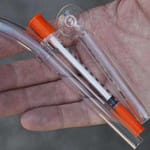
Health and Safety Code Section 11364 criminalizes possessing items used for unlawfully injecting or smoking controlled substances. Paraphernalia includes pipes, syringes, and similar devices.
This misdemeanor carries up to six months in county jail and fines up to $1,000. Prosecutors must prove you possessed the object, knew of its presence, and understood its purpose for consuming controlled substances.
Paraphernalia charges become strategic in combined cases. Items like pipes or syringes suggest personal use, potentially supporting your defense against intent to sell accusations. Conversely, scales, measuring instruments, or packaging materials strengthen prosecution claims of distribution intent.
A recent arrest illustrates these combined charges. Authorities arrested a woman for prostitution alongside two counts of drug paraphernalia possession, two counts of intentional possession of controlled substances, and one count of possession with intent to distribute after discovering fentanyl packets, crystal methamphetamine, a digital scale, and hypodermic needles.
How Combined Charges Affect Your Case
Why These Charges Are Often Filed Together
Prosecutors file prostitution and drug charges together because the circumstances creating one arrest often reveal evidence of the other. Law enforcement discovers controlled substances during prostitution investigations when suspects carry drugs, paraphernalia appears in plain view during questioning, or individuals exhibit signs of intoxication that prompt searches [5].
A Baltimore case illustrates this pattern. Authorities charged a defendant with taking a person to engage in prostitution alongside possession with intent to distribute controlled substances. The defendant traveled with females from North Carolina to Maryland for commercial sex acts while aware they were highly dependent on heroin and cocaine. This dependency created the connection prosecutors used to file both charges simultaneously.
Drug dependency among individuals engaged in prostitution creates a practical link prosecutors exploit. When arrests occur, the presence of drugs transforms a single misdemeanor into multiple charges carrying separate penalties.
Enhanced Penalties for Multiple Offenses
Sentence enhancements add time to your base prostitution sentence when combined with drug convictions. California uses over 100 unique enhancements that lengthen sentences. Roughly 40% of prison admissions since 2015 have sentences lengthened by enhancements, while 70% of currently incarcerated individuals face enhanced sentences.
Enhancements increase average sentences by approximately 1.9 years, representing a 48% increase for all admissions. The impact grows larger for people receiving longer sentences. At the 75th percentile, enhancements increase sentences from 4 to 6 years, and from 6.7 to 12 years at the 90th percentile [5].
Courts apply specific rules when multiple enhancements exist. California law prohibits imposing more than one enhancement for the same prohibited behavior. When multiple enhancements address the same conduct, only the longer enhancement applies. Note that this limitation doesn't prevent courts from imposing different enhancement types for different behaviors within the same case.
Impact on Plea Bargaining Options
Combined charges shift plea bargaining dynamics significantly. Prosecutors hold stronger negotiating positions when multiple charges exist, using the threat of enhanced sentences to pressure defendants toward accepting plea deals. The possibility of facing both prostitution and drug convictions creates uncertainty about trial outcomes.
Enhancements play an important role in the plea-bargaining process. Defense attorneys may negotiate to have prosecutors drop enhancements in exchange for guilty pleas. In particular, prostitution cases sometimes resolve through pleas to lesser charges like disturbing the peace or criminal trespass.
Your leverage decreases when facing multiple charges because prosecutors can offer to dismiss one charge while maintaining another. This creates pressure to accept deals that might seem favorable compared to facing trial on all charges, even when individual charges lack strong evidence.
Prior Criminal History Considerations
Prior convictions intensify the prostitution sentence impact when new charges arise. Your criminal history directly affects penalties judges impose. Prosecutors rely on prior convictions to argue for tougher penalties, highlighting patterns of behavior or probation violations.
California's Three Strikes Law creates the harshest enhancement scenario. A second strike results in double the usual prison term, while a third strike leads to sentences of 25 years to life in prison. Defendants must serve 80% of their sentence before release eligibility.
Prior convictions also affect charging decisions. Judges typically issue middle or upper term sentences rather than lower terms when defendants have criminal histories. Past convictions suggest an inability to rehabilitate, influencing judicial discretion at sentencing. Repeat drug offenders face increased penalties and reduced opportunities for diversion programs.
Sentencing Guidelines for Prostitution and Drug Charges
Standard Sentencing for Prostitution Offenses
Judges impose varying penalties based on conviction history. First-time prostitution offenders face up to six months in county jail and fines reaching $1,000. Courts often grant probation instead of jail time, requiring counseling or participation in rehabilitation programs.
Second convictions carry mandatory minimums. Prosecutors cannot waive the 45-day jail requirement, and probation cannot replace this mandatory term. Third or subsequent violations require minimum 90-day sentences in county jail. Judges exercise discretion to determine exact sentence length within these parameters, following California Rules of Court guidelines.
Solicitation involving minors triggers substantially harsher penalties. When defendants 18 or older solicit minors, sentences range from two days minimum to one year maximum in county jail, with fines up to $10,000 [1]. If the minor was under 16, or trafficked under Section 236.1, penalties increase further [1].
Sentencing Ranges for Drug Crimes
Simple possession under Health and Safety Code 11350 became a misdemeanor following Proposition 47, carrying up to one year in county jail and $1,000 fines. Possession for sale under Section 11351 remains a felony with two to four years in state prison and fines reaching $20,000.
Drug trafficking involving interstate transport can result in five years to life in federal prison with fines exceeding $100,000. Penalties escalate based on drug schedule classification, quantity possessed, and criminal history [5].
Factors That Increase Sentences
Location matters significantly. Offenses within 1,000 feet of schools trigger enhanced penalties. Similarly, prostitution near residential structures within this distance allows judges to suspend driving privileges for 30 days.
Minor involvement creates aggravating circumstances leading to sentence enhancements. Weapon presence during drug offenses, even without use, results in additional penalties. Large drug quantities exceeding personal use amounts increase sentences substantially.
Alternative Sentencing Options
California judges approve alternatives to incarceration based on offense seriousness, criminal history, violence absence, and rehabilitation likelihood. Probation permits community supervision instead of jail, typically lasting one to three years for misdemeanors and up to five years for felonies.
Community service substitutes for fines or incarceration through unpaid volunteer work [2]. House arrest with electronic monitoring allows offenders to maintain employment while serving sentences at home. Work release programs permit daytime employment with nightly return to detention facilities.
Diversion Programs and Rehabilitation
PC 1000 diversion allows eligible defendants facing simple possession to complete 18-month education and treatment programs without guilty pleas, resulting in charge dismissals upon successful completion. Proposition 36 offers probation-based drug treatment lasting one year, though judges aren't obligated to dismiss cases after completion.
Drug Court provides flexible treatment programs where successful participants typically receive dismissals. Los Angeles offers prostitution-specific diversion at East Los Angeles and Long Beach courthouses, featuring one-day classes requiring one year without new arrests before dismissal. First-time offenders without violence or drug conviction histories may qualify for these programs.
What to Do If You're Facing These Charges
Your Rights During Arrest and Questioning
Miranda warnings protect your constitutional rights during custodial interrogation. You can remain silent and refuse to answer questions without an attorney present. Police must inform you of these rights before questioning you while in custody, though they aren't required to read them immediately upon arrest. Any information you voluntarily provide before receiving this warning can be used against you in court.
Request an attorney immediately and decline to speak. Politely state: "I want to remain silent and speak to an attorney". If police continue questioning after you invoke these rights, those statements cannot be used in court.
Why You Need an Attorney Immediately
Early legal intervention allows your attorney to gather critical evidence, review police reports, and consult witnesses from the start. Attorneys identify when officers' beliefs about your actions were false or unreliable. They challenge evidence validity, negotiate with prosecutors for reduced charges, and potentially dismiss cases entirely.
Delaying representation risks missing opportunities to challenge evidence before it enters court records. Experienced attorneys protect you from coerced statements and unfavorable deals.
Building Your Defense Strategy
Prosecutors must prove beyond reasonable doubt that you specifically intended to engage in prostitution. Defense attorneys examine whether entrapment occurred when undercover officers pressured you in overbearing ways. They file motions to suppress evidence obtained through illegal searches. Statements made without proper Miranda warnings can be excluded [5].
Steps to Take Before Your Court Date
Avoid making any statements or signing documents without your attorney. Do not use jail telephones, as conversations are recorded. At arraignment, the court formally notifies you of charges and advises you of fundamental rights. Your attorney ensures decisions made during this first appearance align with your long-term defense goals.
Need An Attorney?
Facing combined prostitution and drug charges creates serious legal challenges that demand immediate attention. The penalties escalate significantly when prosecutors file multiple offenses together, affecting everything from jail time to your eligibility for diversion programs. On balance, your location within Los Angeles County, criminal history, and the specific circumstances of your arrest will determine the prosecution's approach.
The key to protecting your future is securing experienced legal representation without delay. An attorney can identify weaknesses in the prosecution's case, negotiate for reduced charges, and potentially secure dismissal. Take advantage of available diversion programs and alternative sentencing options, as long as you act quickly and avoid making statements that could damage your defense.
References
[1] – https://codes.findlaw.com/ca/penal-code/pen-sect-647/
[2] – https://www.saccourt.ca.gov/criminal/alternative-sentencing.aspx
[3] – https://leginfo.legislature.ca.gov/faces/codes_displaySection.xhtml?sectionNum=647.&lawCode=PEN
[4] – https://leginfo.legislature.ca.gov/faces/codes_displaySection.xhtml?lawCode=HSC§ionNum=11350
[5] – https://courts.ca.gov/sites/default/files/courts/default/2024-08/prop47faqs.pdf
Need an Attorney? CALL NOW: 213-932-8922
Yuliya Kelmansky is an Expert Attorney who has over 10 years of practice defending a variety of cases.