

Carrying a Concealed Weapon California
Carrying a concealed weapon California charges can result from firearms that don’t even belong to you. California law holds individuals accountable for weapons found in their vehicles or on their property, regardless of actual ownership. Consequently, you could face serious criminal charges for a passenger’s gun, a firearm left in a borrowed car, or a weapon you never knew existed. Understanding constructive possession laws is crucial for protecting yourself. This article explains when you can be charged for someone else’s gun, common scenarios leading to prosecution, available legal defenses, and essential steps to take if facing weapons charges.
Understanding California’s Concealed Weapon Laws
What qualifies as a concealed weapon in California
California Penal Code 25400 defines carrying a concealed weapon as possessing a pistol, revolver, or other firearm capable of being concealed either on your person or within a vehicle under your control. The weapon doesn’t need to be completely hidden to violate this law. A firearm is considered concealed if it is substantially hidden from ordinary view, even when part of it remains visible.
A handgun tucked into a waistband with only the grip exposed qualifies as concealed. Similarly, firearms inside purses, backpacks, briefcases, glove compartments, or under car seats all meet the legal definition of concealment. Firearms carried openly in belt holsters are not concealed. However, separate statutes prohibit openly carrying firearms in California, making legal firearm transportation particularly restrictive.
The law applies to any device designed as a weapon that expels a projectile through explosion or combustion and has a barrel less than 16 inches in length. This includes pistols, revolvers, handguns, short-barreled rifles, and short-barreled shotguns. Pellet guns and BB guns, which rely on air pressure rather than combustion, do not qualify as firearms under this statute.
How California defines illegal possession
California law recognizes both actual and constructive possession when prosecuting firearm cases. Prosecutors must prove three elements for a conviction: you carried a firearm capable of being concealed, you knew you were carrying it, and the firearm was substantially concealed. The knowledge requirement becomes crucial in cases involving other people’s firearms.
Carrying a concealed weapon california violations are typically charged as misdemeanors, punishable by imprisonment in county jail not exceeding one year, a fine up to USD 1,000, or both. However, the offense becomes a felony under aggravating circumstances. You face felony charges if you have a prior felony conviction, the firearm was stolen and you knew it, you are an active participant in a criminal street gang, or you are prohibited from possessing firearms under Penal Code 29800.
A loaded concealed firearm that you’re not registered as owning with the Department of Justice triggers enhanced penalties. First-time violations of Penal Code 25850, which prohibits carrying loaded firearms in public or vehicles, can result in up to one year in county jail and a fine up to USD 1,000. Prior convictions or stolen weapons elevate charges to felonies.
The role of vehicle ownership in gun charges
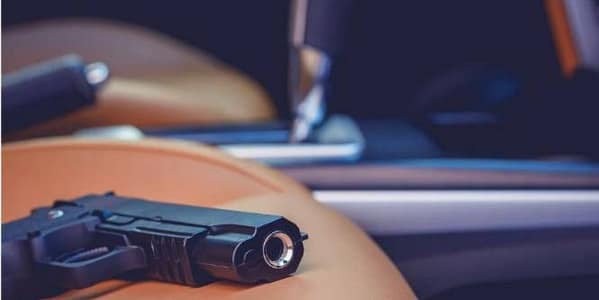
Vehicle ownership plays a significant role in concealed weapon charges. Penal Code 25400 specifically criminalizes carrying concealed firearms within any vehicle under your control or direction. Inasmuch as the law focuses on control rather than ownership, you can face charges for guns in borrowed, rented, or shared vehicles.
California law makes it unlawful for a driver or owner of a motor vehicle to knowingly permit another person to carry a firearm into the vehicle in violation of concealment laws. This creates liability for vehicle owners even when passengers bring weapons into the car. Without a valid CCW permit, handguns must be unloaded and placed in a locked container or the vehicle’s trunk. The glove box and center console do not qualify as locked containers.
A locked container must be fully enclosed and secured by a padlock, key lock, combination lock, or similar locking device. Long guns like rifles and shotguns must be unloaded but aren’t required to be in locked containers. Keeping a gun under a seat or in a backpack, even unloaded and registered, violates California’s storage requirements.
Call 213-932-8922, for a free consultation.

Can You Be Charged for Someone Else’s Gun in Your Car?
Legal concept of constructive possession
Prosecutors don’t need to prove you physically held a firearm to pursue carrying a concealed weapon California charges. The state recognizes constructive possession, which allows conviction even when the weapon wasn’t on your person at arrest. This legal theory applies when you had the ability and intent to exercise control over a gun, regardless of whether you touched it.
Actual possession means physically having the firearm on your body, such as holding it in your hand, carrying it in your waistband, jacket, or backpack. Constructive possession exists when you don’t physically hold the gun but have the ability and intent to exercise control over it. A gun hidden in your bedroom closet, glove compartment, or locked trunk could lead to constructive possession charges if prosecutors believe you knew it was there and could access it.
The prosecution must prove two critical elements: you knew the firearm existed, and you had the ability to access or control it. These cases often rely on circumstantial evidence rather than direct proof. Being near a gun doesn’t automatically equal possessing it. If several people had access to the area where the firearm was found, prosecutors face a harder job proving you personally exercised control.
When passengers’ firearms become your problem
A handgun found under the passenger seat creates potential liability for the driver. If you’re stopped while driving and a firearm is discovered under the passenger seat, you may be considered in actual possession. However, if a passenger accompanies you, the charge might shift to constructive possession.
Mere presence as a passenger when another person has a gun doesn’t automatically impose legal liability. Yet prosecutors frequently file constructive possession cases when firearms are discovered in places multiple people use. Shared vehicles present particularly complex situations where establishing individual control becomes challenging.
Scenarios where you can face charges
Prosecutors pursue charges in several common situations. A handgun found in the glovebox, center console, or under the seat of a borrowed or shared car frequently triggers investigations. Firearms stored in closets, garages, or bedrooms used by multiple people create similar issues. Guns discovered in backpacks, duffel bags, or luggage that others accessed raise immediate questions about knowledge and control.
Borrowed or rented vehicles with hidden firearms create particularly dangerous scenarios. You might never know the previous driver left a weapon behind. Similarly, family members leaving guns in shared vehicles without informing you can result in unexpected charges during routine traffic stops.
What prosecutors must prove
Under Penal Code 25400, finding a gun in the car isn’t sufficient for conviction. Prosecutors must prove beyond reasonable doubt that you knew the gun was there, you carried the gun in the car, the gun was substantially concealed, and the car was under your control or direction. This becomes especially important when the gun was in the trunk, the car was borrowed, multiple passengers were present, or the firearm was hidden in a locked container.
Prosecutors must establish the firearm was loaded, in your possession or control, and that you knew about its presence. Knowledge and intent form the foundation of constructive possession charges. Without clear proof connecting you to both elements, charges may not withstand legal scrutiny.
Common Situations That Lead to Charges for Another Person’s Gun
Real-world scenarios show how easily you can face charges for firearms you never placed in a vehicle. Traffic stops, rental car mix-ups, and passenger weapons create the most common pathways to prosecution.
Borrowed or rented vehicles with hidden firearms
A San Antonio mother rented a vehicle and drove it for more than a week before discovering a loaded gun on the floorboard, right below where her nine-year-old daughter sat. She also found an ax under the driver’s seat days earlier. According to her statement, she could have faced jail time and child protective services involvement if stopped by police on school grounds with the stolen weapon.
Similar incidents occur regularly with rental cars. A Massachusetts mother rented from Enterprise for 24 hours and later learned from Norwood police that a loaded handgun was in the glove box the entire time. A Virginia woman found a loaded 9-millimeter handgun in the pocket behind the driver’s seat, next to her four-year-old daughter’s car seat, after Enterprise called her a day after renting. In light of these cases, rental companies state they have policies requiring staff to check under seats, in glove compartments, center consoles, and door compartments. Still, weapons slip through inspections and put unsuspecting renters at risk of carrying a concealed weapon California charges.
Passengers carrying concealed weapons
Passenger firearms create immediate liability during traffic stops. In Fresno, officers stopped a vehicle and the passenger admitted to possessing a concealed firearm in his waistband. The firearm was recovered and found not to be registered to the passenger. The passenger faced arrest while the driver’s car was towed.
A Monterey County case illustrates gang-related complications. Officers stopped Michael Ray Gonzalez with two 15-year-old passengers. One boy told officers he carried a loaded gun while getting out of the car, wearing baggy clothing that concealed the weapon. The functional .45-caliber semiautomatic pistol had been reported stolen. Gonzalez faced charges under Penal Code 26100(a) for knowingly permitting another person to carry a loaded firearm in his vehicle.
Family members leaving guns in shared vehicles
Shared family vehicles present particularly dangerous situations. Firearms left by one family member can result in charges against another who uses the car without knowledge of the weapon’s presence.
Guns found during traffic stops
Minor violations frequently lead to weapon discoveries. A suspended driver stopped for an unsafe turn was found with a loaded, unregistered Colt .38 Special under the seat, along with open containers, methamphetamine, and cocaine. Traffic stops for broken taillights, illegal window tint, or rolling through stop signs routinely escalate when officers find firearms. Prior to arrest, these stops appear routine. At the same time, loaded firearms discovered near schools or busy areas can result in immediate detention.
Legal Defenses When Charged for Someone Else’s Firearm
Several defenses exist when facing carrying a concealed weapon California charges for firearms you didn’t own or know about. Defense attorneys focus on attacking the prosecution’s evidence and proving elements weren’t satisfied beyond reasonable doubt.
Lack of knowledge defense
Penal Code 25400 requires you knew or should have known a gun was in your possession or vehicle. If you didn’t realize the gun existed, you cannot be convicted. Someone else may have placed the firearm in your jacket, purse, briefcase, or vehicle without your awareness.
Defense attorneys often focus on the knowledge prong, demonstrating the weapon was hidden, newly placed, or found in a shared area. This leaves prosecutors short of proof that you truly realized the gun existed. Prosecutors must prove you knew the weapon was there; lack of knowledge creates reasonable doubt.
Challenging possession and control
Constructive possession cases require proving you had both access to the gun and intent to control it. You may not have control over the area where the weapon was found. The closet might be locked, or others had equal access. Cross-examination exposes these uncertainties.
Physical contact isn’t required, but prosecutors must still establish dominion and control. Control doesn’t need to be exclusive, yet close proximity alone isn’t adequate to prove constructive possession.
Proving the gun belonged to another person
Co-occupants sometimes blame clients to dodge their own liability. Defense attorneys use forensic testing, texts, and CCTV to show someone else possessed the firearm. Demonstrating lawful ownership by another party weakens the government’s case against you.
Questioning the legality of the search
If police obtained your gun through an illegal search that violated your Fourth Amendment Constitutional rights, that evidence may be excluded or thrown out of court. Attorneys file Penal Code Section 1538.5 motions when officers rummage through drawers without consent or a warrant. Suppressing the gun ends the case.
Body-cam gaps, conflicting search-warrant affidavits, or stale probable cause often swing rulings in favor of defendants. If law enforcement discovered the firearm without a valid warrant, probable cause, or your consent, the evidence could be deemed inadmissible in court.
Valid CCW permit as a defense
If you have a CCW permit, carrying a gun is legal in California. You bear the burden of proving you have a valid license. A valid CCW permit at the time of arrest means the charge may not apply.
What to Do If You’re Stopped or Charged
Your rights during a traffic stop
You have the right to remain silent during any police encounter. You don’t need to answer questions about where you’re going, where you’re traveling from, or what you’re doing. If you wish to exercise this right, say so out loud. You do not have to consent to a search of yourself or your belongings, though police may pat down your clothing if they suspect a weapon. Making a timely objection before or during the search can help preserve your rights in any later legal proceeding.
Whether to inform police about firearms
California has no duty to inform law at the state level, though some localities have disclosure requirements. You are not legally required to inform police that you have a gun in the car. Disclosing the presence of a firearm could potentially incriminate you, especially given that carrying a concealed weapon california violations are generally crimes. However, if an officer directly asks whether you have weapons, answer honestly. Lying to an officer during a lawful stop is a crime.
Steps to take if arrested
Do not resist arrest, even if you believe it’s unfair. Exercise your right to remain silent and ask for a lawyer immediately. Don’t give explanations, excuses, or sign anything without legal counsel. You have the right to make a local phone call, and police cannot listen if you call a lawyer. Avoid discussing the case with others or on social media. Preserve documentation related to permits or firearm ownership.
Importance of legal representation
Prosecutors often decide whether to file carrying a concealed weapon california charges within days of arrest. Hiring an attorney early gives your lawyer the chance to contact the District Attorney’s Office before charges are locked in, present evidence in your favor, and push for dismissal or reduced charges. Attorneys can analyze evidence, identify weaknesses in the prosecution’s case, challenge unlawful searches or arrests, and protect your constitutional rights. Early legal intervention often leads to better outcomes.
Conclusion
California’s constructive possession laws mean you can face serious charges for firearms you never owned or knew existed. Rental cars with hidden weapons, passengers carrying guns, or family members leaving firearms in shared vehicles can all lead to criminal prosecution. As a matter of fact, prosecutors pursue these cases regularly, and the consequences can alter your life permanently.
Understanding these laws protects you from unexpected charges. If you’re stopped or arrested for carrying a concealed weapon California violation involving someone else’s firearm, exercise your right to remain silent and contact an experienced attorney immediately. Early legal intervention often makes the difference between conviction and case dismissal.
Call 213-932-8922, for a free consultation.