


Is Peyote Cactus Legal in California? Laws & Penalties Explained
What is Peyote Cactus?
Peyote cactus is a small, spineless cactus scientifically known as Lophophora williamsii that contains psychoactive alkaloids, particularly mescaline. The plant belongs to the Cactaceae family and grows predominantly in limestone soils of the Chihuahuan Desert across southern Texas and northern Mexico. The term "peyote" derives from the Nahuatl word peyōtl, meaning "caterpillar cocoon".
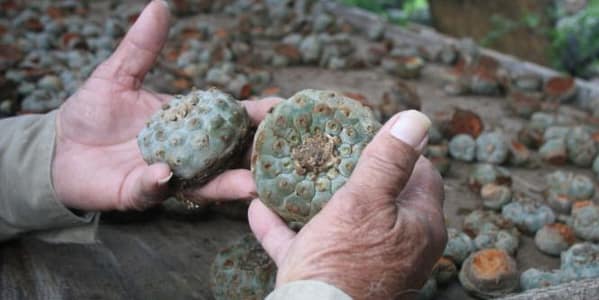
The cactus exhibits distinctive physical characteristics that distinguish it from other species. The plant grows nearly flush with the soil surface, measuring up to 5 inches wide and approximately 3 inches above ground. Its body is soft, fleshy, and hemispherical with a flattened, depressed center, typically appearing bluish-green to grayish-green in color. The stems feature 5 to 13 ribs with tufts of yellow-white hairs at the summit rather than spines. During summer months from May to September, the cactus produces pink to white flowers measuring 0.5 to 1 inch in diameter at the center of the stem.
Peyote contains psychoactive alkaloids, with mescaline serving as the principal hallucinogenic compound. Fresh buttons contain approximately 0.4% mescaline concentration, while dried buttons contain up to 6% mescaline by weight. The plant produces at least 28 different alkaloids, though mescaline remains the primary psychoactive agent. Fresh buttons can contain up to 8% total alkaloids, with concentrations accumulating as the plant ages.
The cactus demonstrates remarkably slow growth patterns, requiring 10 to 30 years to reach maturity before flowering. After flowering, the plant produces a pink, bitter-tasting berry fruit containing black seeds, which ripens up to one year following pollination. The plant possesses a fleshy, carrot-shaped taproot system that extends below the visible above-ground portion.
Indigenous peoples of the Americas have utilized peyote for over 5,000 years in ceremonial, spiritual, and folk medicine practices. The "buttons," formed by cutting and drying the crown of the cactus, can be chewed, soaked in water to produce a liquid, ground into powder for capsules, or smoked. The psychoactive effects typically last up to 12 hours.
Is Peyote Legal in California?
Peyote remains prohibited under California state law with limited exceptions for specific religious use. The state classifies mescaline, the primary psychoactive compound in peyote, as a Schedule I controlled substance, placing it in the same legal category as heroin and LSD. California law criminalizes both cultivation and possession of peyote through distinct statutory provisions, with cultivation carrying more severe penalties than simple possession.
Cultivation Laws Under HS 11363
California Health & Safety Code Section 11363 HS prohibits any person from planting, cultivating, harvesting, drying, or processing any plant of the genus Lophophora. The statute applies to peyote cultivation for any purpose, including religious ceremonies. Prosecutors must establish two elements to secure a conviction: the defendant participated in planting, cultivating, harvesting, or processing peyote, and the defendant recognized the plant as peyote.
The offense functions as a wobbler, permitting prosecution as either a misdemeanor or felony based on factors including the amount of peyote involved, case circumstances, and the defendant's criminal history. Misdemeanor convictions result in county jail imprisonment for up to one year and fines reaching $1,000. Felony convictions carry state prison sentences of up to three years and fines up to $10,000.
Federal reservations within California boundaries represent the sole locations where lawful peyote cultivation occurs. Tribal lands operate under federal jurisdiction rather than California law, which permits peyote cultivation for religious purposes in specified circumstances. Native Americans face prosecution for cultivating peyote outside federal reservation boundaries.
Possession Laws Under HS 11350
California Health & Safety Code Section 11350(a) HS governs possession of controlled substances, including peyote. The statute prohibits possession of substances specified in various subdivisions of Section 11054, 11055, and 11056 without a valid prescription from a licensed physician, dentist, podiatrist, or veterinarian. Violations typically constitute misdemeanors punishable by county jail imprisonment for up to one year.
Cultivating peyote under HS 11363 represents a more serious offense than simple possession under HS 11350. Possession charges can escalate to felony status when defendants have prior convictions for specified serious felonies or sex crimes requiring registration.

Call Now 213-932-8922, for a free consultation.
Religious Exemptions for Peyote Use
Federal law provides specific religious exemptions for peyote use by members of the Native American Church, despite the substance's classification as a Schedule I controlled substance under the Controlled Substances Act. The 1994 amendments to the American Indian Religious Freedom Act explicitly protect the traditional ceremonial use of peyote by Native peoples, establishing that use, possession, or transportation of peyote by an Indian for bona fide traditional ceremonial purposes in connection with the practice of a traditional Indian religion is lawful and shall not be prohibited by the United States or any state. The peyote religion represents one of the oldest practiced religions in the Western Hemisphere, with an estimated 250,000 Native peoples participating in ceremonies where peyote serves as a sacrament embodying a spiritual deity.
The current legal framework emerged following the 1990 Supreme Court decision in Employment Division of Oregon v. Smith, which held that the First Amendment does not protect Indian practitioners who use peyote in Indian religious ceremonies. In that case, two Native Americans were fired from their state jobs in Oregon for participating in a peyote ceremony and subsequently denied unemployment benefits. The Supreme Court ruled in favor of Oregon, determining that those who use peyote ceremonially are subject to the consequences of the state's generally applicable law prohibiting drug use. In effect, this decision created a situation where Indian ceremonial use was legal in some states but not in others.
This controversial ruling prompted Congress to pass the Religious Freedom Restoration Act in 1993, followed by the 1994 amendments that restored federal protections. Under 21 CFR § 1307.31, NAC members are exempt from criminal prosecution for religious peyote use. The exemption extends to other bona fide religions in which the use of peyote is central to established religious beliefs, practices, dogmas, or rituals. Federal rulings such as US v. Boyll (1991) allow members to transport, possess, and use peyote for religious purposes.
Despite federal protections, California maintains no corresponding state exemption for peyote cultivation or use in religious ceremonies. Native Americans who grow peyote for religious ceremonies face criminal liability under California Health & Safety Code Section 11363 HSC because the state has not enacted laws conforming with federal regulations protecting ceremonial peyote use.
Penalties for Peyote Violations in California
Violations involving peyote in California carry penalties that vary based on whether charges are filed as misdemeanors or felonies. Both cultivation under HS 11363 and possession under HS 11350 function as wobbler offenses, permitting prosecutors to pursue either charge level depending on the quantity of peyote involved, specific case circumstances, and the defendant's prior criminal record.
Misdemeanor Penalties
Misdemeanor convictions for peyote violations result in imprisonment in county jail for up to one year. Courts may impose formal or summary probation typically lasting one to three years as an alternative or supplement to incarceration. Financial penalties include court-ordered fines reaching $1,000, plus substantial court assessments that increase the total monetary obligation.
Convicted individuals face mandatory participation in drug counseling or substance abuse programs as a condition of sentencing. Judges retain discretion to structure probation terms based on case specifics, whereas defendants serving jail sentences must complete at least 50% of their time in custody. For first-time offenders granted probation, courts impose minimum fines of $1,000 or community service requirements. Second or subsequent offenses increase the minimum fine to $2,000 or mandatory community service if the defendant lacks ability to pay.
Felony Penalties
Felony peyote convictions carry state prison sentences of 16 months, 2 years, or 3 years under California's realignment program. Unlike misdemeanor sentences served in county facilities, felony terms result in state prison placement. Maximum criminal fines reach $10,000 for felony convictions. Courts may impose formal probation under county probation officer supervision rather than immediate incarceration, though felony probation carries stricter monitoring requirements than misdemeanor probation.
Felony convictions create permanent criminal records that trigger lifetime prohibitions on firearm ownership or possession under California law. This restriction applies regardless of whether the defendant receives probation or serves prison time. Possession charges escalate to felony status when defendants have prior convictions for sex crimes requiring registration or serious felonies specified under California Penal Code Section 667. In such cases, defendants face 16 months, 2 years, or 3 years in jail and maximum fines of $10,000.
Common Legal Defenses Against Peyote Charges
Defendants charged with peyote violations in California can assert multiple legal defenses to challenge prosecution or seek case dismissal. Defense strategies depend on case circumstances, evidence collection methods, and the defendant's intent and knowledge regarding the controlled substance.
Mistake of Fact Defense
The mistake of fact defense applies when defendants can demonstrate they did not know the plant they cultivated or possessed was peyote. This defense negates the intent element required for conviction under Health & Safety Code Section 11363, as prosecutors must prove defendants not only grew or possessed peyote but also recognized it as such. California jury instruction CALCRIM 3406 establishes this defense for both general and specific intent crimes, with the distinction that mistakes must be reasonable for general intent crimes but need not be reasonable for specific intent crimes. Defendants might assert they believed the plant was another type of cactus species rather than Lophophora williamsii. The burden rests on prosecutors to establish beyond reasonable doubt that defendants possessed knowledge of the substance's identity.
Religious Freedom Defense
The religious freedom defense presents significant limitations under California law, particularly for cultivation charges. The California Supreme Court has held that individuals cannot be convicted of simple possession when using peyote as part of legitimate religious rituals. However, courts have not extended this reasoning to cultivation offenses under HS 11363. Accordingly, defendants who plant or harvest peyote for religious purposes may still face conviction despite federal protections for ceremonial use. This defense proves especially complex when cultivation occurs outside federal reservation lands.
Illegal Search and Seizure Defense
The Fourth Amendment protects individuals from unreasonable searches and seizures, providing grounds to challenge evidence obtained through constitutional violations. Defense attorneys can file motions to suppress evidence when peyote was discovered during unlawful searches conducted without proper warrants, probable cause, or valid consent. The exclusionary rule prohibits prosecutors from using illegally obtained evidence to prove possession or cultivation charges. Successful suppression motions often result in case dismissal when excluded evidence was essential to prosecution.
How Federal and State Peyote Laws Differ
Federal and California peyote laws diverge significantly in jurisdictional scope, enforcement authority, and exemption frameworks. Federal law classifies peyote as a Schedule I controlled substance under the Controlled Substances Act, yet 21 CFR § 1307.31 exempts nondrug use in bona fide religious ceremonies of the Native American Church from this classification. California maintains no parallel exemption in its statutes, creating enforcement disparities within state boundaries.
Tribal reservation lands within California operate under federal jurisdiction rather than state authority, permitting lawful peyote cultivation on these designated territories. California law cannot be enforced on reservation lands, establishing geographic zones where federal religious exemptions supersede state prohibitions. Native Americans cultivating peyote outside federal reservation boundaries remain subject to prosecution under Health & Safety Code 11363.
State-level peyote regulations vary substantially across the United States. While at least 28 states have enacted laws conforming with federal regulations protecting ceremonial peyote use, 22 states have not adopted similar protections. California falls among states that strictly limit peyote to religious use with aggressive prosecution for unauthorized possession.
The California Supreme Court established that possession for legitimate religious purposes cannot result in prosecution, yet courts have not extended this reasoning to cultivation offenses. Specifically, planting or harvesting peyote for religious purposes may still constitute criminal violations under state law despite federal protections for ceremonial use.
Need a Criminal Defense Attorney? CALL NOW: 213-932-8922
Yuliya Kelmansky is an Expert Criminal Defense Attorney who has over 10 years of practice defending a variety of criminal cases.