



The Legal Reality of AI Conversations as Evidence
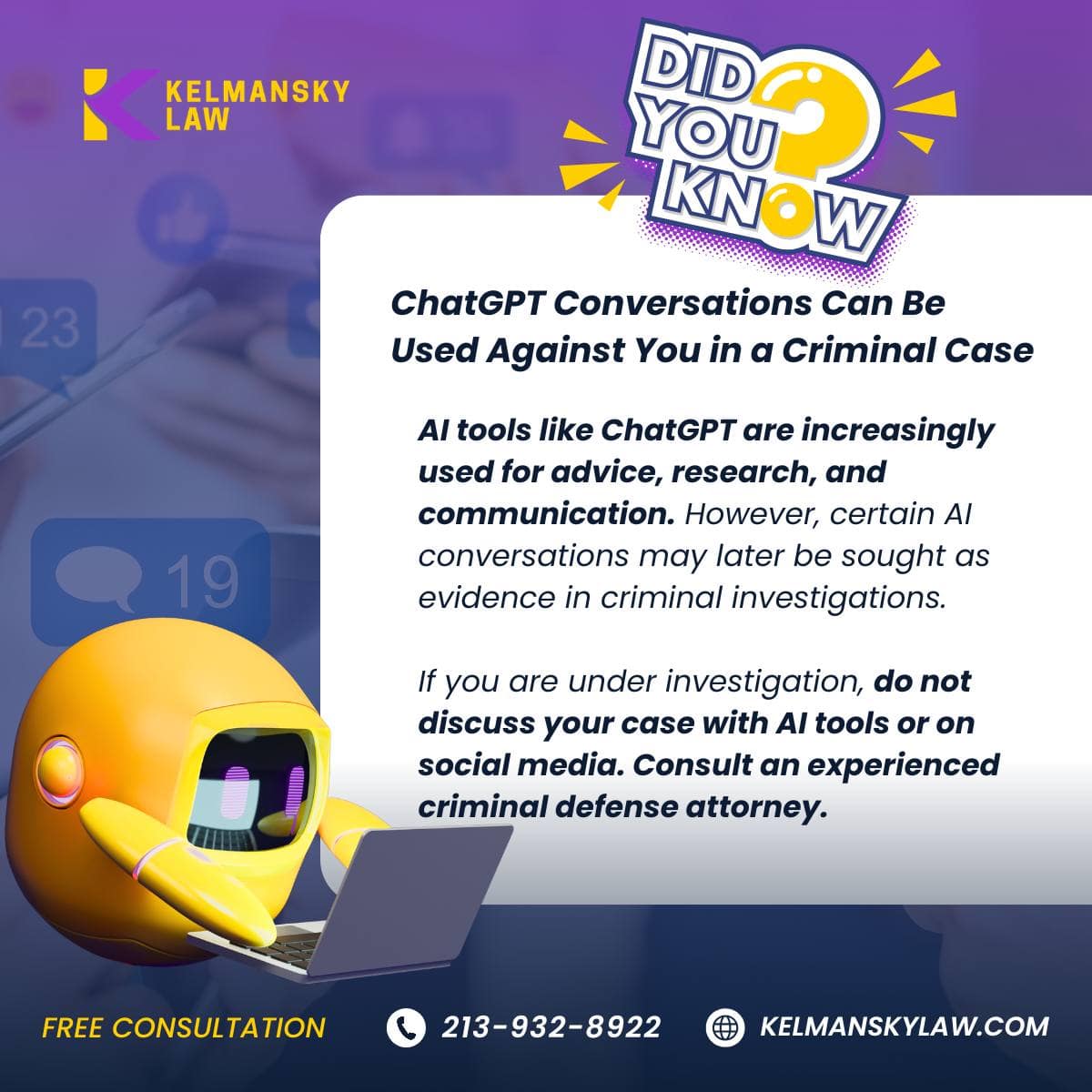
Can ChatGPT be used in court? The answer is yes. Courts across the country are already accepting ChatGPT conversations as evidence in criminal and civil cases. Your AI chat history carries the same legal weight as emails, text messages, or any other digital communication.
Significantly, these conversations lack legal protections like attorney-client privilege or doctor-patient confidentiality. Law enforcement and opposing counsel can subpoena your ChatGPT logs, and AI platforms must comply with these requests.
This guide explains how courts treat AI evidence, when your conversations can be used against you, and what steps you should take to protect yourself.
Yes, ChatGPT Conversations Can Be Used as Evidence in Court
AI conversations entered the courtroom as evidence in late 2025 when authorities charged Jonathan Rinderknecht for starting the Pacific Palisades fire in Los Angeles. Justice department officials cited Rinderknecht's ChatGPT history, which revealed questions like "Are you at fault if a fire is lift [sic] because of your cigarettes?" along with AI-generated images of a burning city. This case marked a turning point in how digital evidence is collected and presented in legal proceedings.
Recent Cases Where AI Chats Became Evidence
Criminal prosecutors are increasingly relying on AI chat histories to establish intent and motive. Ja-Zion Robertson, an 18-year-old male in Virginia, received a 25-year sentence for first-degree murder in September 2025 after asking Snapchat's My AI bot, "What if I shot them if they step on my property with hostile intent?". Identically, investigators linked 19-year-old Ryan Schaefer to a vandalism spree in October 2025 through ChatGPT messages such as, "qill I go to jail," "I was smashing the windshields of random fs cars," and "I got away w it last year. And I don't think there's any way they could know my face".
In U.S. v. Heppner, the U.S. District Court for the Southern District of New York ruled that a criminal defendant's conversations with an AI chatbot about his case could not be protected by attorney-client privilege or the work-product doctrine. The court found the defendant had used the AI to analyze legal issues and assist with communications, but sought to withhold the chats from prosecutors under an assertion of privilege. The ruling established that the AI platform was a third party, not a lawyer, and the communications were not made in confidence.
ChatGPT Conversations Are Not Legally Protected
Most people assume their private conversations with AI assistants carry the same protections as discussions with licensed professionals. That assumption is wrong and potentially dangerous. Courts have ruled definitively that AI conversations receive no legal protection whatsoever.
No Attorney-Client Privilege
Attorney-client privilege requires three elements: communication between a client and attorney, confidentiality, and the purpose of obtaining legal advice. AI platforms fail all three tests.
Judge Jed Rakoff addressed this directly in United States v. Heppner when a criminal defendant tried to shield his Claude AI conversations from prosecutors. The court rejected the claim outright. An AI tool is not a lawyer, has no law license, owes no duty of loyalty, and cannot form an attorney-client relationship. Discussing legal matters with an AI platform is legally no different from talking through your case with a friend.
The confidentiality requirement fails even more dramatically. Anthropic's policy expressly states that user prompts and outputs may be disclosed to governmental regulatory authorities and used to train the AI model. OpenAI's privacy policy contains comparable provisions permitting data use for model training and disclosure in response to legal process. When you voluntarily submit content to systems that retain and may share it, you have no reasonable expectation of confidentiality.
This misconception is widespread and alarming. A striking 67% of AI users believe their conversations with AI should have the same legal protections as conversations with lawyers or doctors. Meanwhile, 56% now seek legal advice from these platforms, and half are unaware their conversations can be subpoenaed in court.
OpenAI CEO Sam Altman acknowledged the problem publicly, stating that ChatGPT does not provide legal privilege or legal confidentiality and "we haven't figured that out yet". He noted that people discuss their most personal matters with ChatGPT, but unlike conversations with therapists, lawyers, or doctors, there's no legal privilege.
No Doctor-Patient Confidentiality
The same absence of protection applies to medical conversations. AI platforms are not HIPAA-compliant entities. Once you enter health information into ChatGPT, it is on OpenAI servers, and they are not HIPAA compliant. That constitutes a technical data breach under federal law.
Physicians who input protected health information into consumer AI platforms violate HIPAA regardless of whether they've opted out of model training. The data has left the protected health system.
When AI Conversations Become Part of a Federal Criminal Investigation
The 2025 Palm Springs fertility clinic bombing investigation illustrates how artificial intelligence chat platforms can become a significant source of evidence in serious criminal cases. According to federal authorities, investigators recovered records showing that the primary bombing suspect allegedly used a generative AI chatbot to research explosives, explosive mixtures, detonation methods, and bomb-making techniques before carrying out the attack. Federal prosecutors later cited AI chat records as part of the evidence supporting charges against an alleged accomplice accused of providing materials used in the bombing.
The FBI alleged that the suspect used an AI chat application to obtain information about ammonium nitrate-based explosives and other technical details related to constructing a powerful explosive device. Investigators reportedly reviewed digital evidence from phones, internet activity, communications, and AI chat records as they reconstructed the planning and preparation that preceded the attack.
For criminal defense attorneys, the case highlights a rapidly emerging issue in digital evidence law: whether AI conversations can be used to prove intent, planning, motive, or knowledge. Prosecutors may argue that specific AI prompts demonstrate preparation for a crime, while defense attorneys may challenge the context of those conversations, the accuracy of the records, and whether researching a topic necessarily proves criminal intent. A person may search for information out of curiosity, academic interest, fiction writing, or other lawful purposes, making context critical in determining the evidentiary value of an AI conversation.
As artificial intelligence tools become increasingly integrated into everyday life, law enforcement agencies are expected to seek AI chat records more frequently in criminal investigations. The Palm Springs bombing case serves as one of the earliest high-profile examples in which federal authorities publicly identified AI chatbot interactions as part of the evidence trail used to investigate and prosecute an alleged act of domestic terrorism.
How Law Enforcement and Lawyers Access Your ChatGPT History
Law enforcement and attorneys obtain your ChatGPT conversations through several established legal mechanisms. The most common method involves a search warrant signed by a judge. Under the Stored Communications Act, police can issue subpoenas to force companies to disclose information that identifies users. Investigators also find conversations on a suspect's phone during lawful device searches.
Legal Process for Obtaining AI Chat Logs
Warrants and court orders compel tech companies to turn over user data. Because most AI services require a user account tied to an email or phone number, investigators can request information from specific accounts. A search warrant based on probable cause is required to obtain the content of messages.
IP address tracking provides another avenue. Every online action is tagged with your IP address, a unique identifier for your internet connection. With a warrant, police order your Internet Service Provider to identify the account holder using that IP address at the exact time queries were made. Premium AI subscriptions create an even more direct link through credit card payment information.
Data Retention Policies by AI Providers
OpenAI retains standard chat history indefinitely unless users actively delete conversations. Once deleted, chats are purged from OpenAI's systems within 30 days, except when legal holds apply. Files uploaded to conversations follow similar rules, becoming unavailable via Compliance API immediately after deletion, but OpenAI's internal backups may retain them for up to 30 additional days.
In June 2025, a federal court in the New York Times vs OpenAI lawsuit ordered the company to retain all chats and uploaded files, including deleted ones. All new chats, deletions, and uploads made since June 5, 2025 are preserved under this legal hold. OpenAI stores this data separately in a secure system accessible only to a small, audited legal and security team.
What Happens When You Delete Your Chat History
Deleted chats are removed from your view immediately and permanently deleted from OpenAI's systems within 30 days, unless de-identification or legal exceptions apply. You cannot recover a chat once deleted. However, providers may have legal obligations that override user expectations of deletion. Consequently, OpenAI disclosed that under court order it retains deleted chats for free, Plus, and Pro users even if users believed they had removed them.
Zero data retention agreements exist for some enterprise API users but do not apply to consumer AI tools like ChatGPT Free/Plus or Claude Pro.
When ChatGPT Evidence Can Be Used Against You
AI chat evidence surfaces in three primary legal contexts, each with distinct implications for how your conversations can be weaponized against you.
Criminal Cases and Confession Evidence
Prosecutors present ChatGPT conversations as direct confession evidence. When police searched Ryan Schaefer's phone with his consent, they discovered he had typed "qill I go to jail" and "I was smashing the windshields of random fs cars" to ChatGPT just ten minutes after allegedly vandalizing 17 vehicles. Prosecutors described this as a "troubling dialog" that documented his state of mind immediately after the alleged crime.
The pattern repeats across jurisdictions. Hisham Abugharbieh faced two counts of first-degree murder after investigators found his ChatGPT queries asking "What happens if a human has a put (sic) in a black garbage bag and thrown in a dumpster". His subsequent questions included whether he could legally keep a gun without a license and whether a car's Vehicle Identification Number could be changed. Days later, he asked "Has there been someone who survived a sniper bullet to the head" and "Will my neighbors hear my gun".
Legal experts view these conversations as more revealing than traditional search histories. Cybersecurity attorney Ilia Kolochenko stated that suspects "believe their interactions with AI will remain confidential or will at least remain undisclosed or undiscovered, so they frequently ask very straightforward, very direct questions".
Civil Litigation and Discovery Requests
Courts treat AI interactions as electronically stored information under Federal Rule of Civil Procedure 34(a), which permits discovery of "writings, drawings, graphs, charts, photographs, phonorecords, and other data compilations". AI chat histories fit within this definition.
Rule 26 governs discoverability, requiring evidence to be "relevant to any party's claim or defense" and "proportional to the needs of the case". AI chat histories can reveal a user's intent, knowledge, and thought processes at specific moments in time.
Corporate and Employment Disputes
In corporate litigation, AI chats potentially expose business strategies, internal deliberations, or client discussions. Employment cases present particularly sensitive scenarios. Questions like "Can we fire someone for XYZ?" or "Is it legal to terminate an employee for XYZ?" become highly relevant evidence.
Employees increasingly use AI to draft grievance responses and litigation pleadings, creating discoverable records of their claims and strategies. When employees upload confidential information to AI platforms to help draft complaints, they may commit unauthorized disclosure of confidential information, potentially constituting gross misconduct.
How to Protect Yourself When Using ChatGPT
Protection requires abandoning the illusion of privacy that AI interfaces create. Gartner advises employees to treat information posted to ChatGPT as if posting it on a public site like social media or a public blog. No clear assurances of privacy or confidentiality exist, and information posted may be used to further train the model.
Treat AI Chats Like Public Communication
Assume all information submitted to ChatGPT will be available in the public domain. Never place sensitive information, corporate secrets, personally identifiable information, or software code into the chat box. Information could be used to train the tool and appear in responses to other users' prompts.
Never Discuss Legal Matters with AI
Attorneys must advise clients explicitly that anything input into an AI tool may be discoverable and is almost certainly not privileged. Consider adding this warning to engagement letters and client onboarding processes. Do not assume clients understand the distinction between a private-feeling interface and actual confidential communication.
Understanding Your Digital Footprint
Every online action leaves traces of information that form a digital footprint revealing more about you than many realize. AI conversations contribute to this footprint through data you share intentionally and information collected automatically through tracking technologies.
What Organizations Need to Know
Employers should prohibit AI use related to company or third-party proprietary information, personal information, or customer data as input. Organizations need periodic audits to ensure compliance with AI usage policies and should address training and awareness of these policies.
Need An Attorney?
Your ChatGPT conversations carry the same legal weight as emails or text messages, and courts across the country are already accepting them as evidence. In fact, no legal privilege protects these conversations from discovery or subpoena. AI platforms must comply with legal requests, and deleted chats may still exist on company servers under court order.
The solution is straightforward: treat every AI conversation as public communication. Never share sensitive information, discuss legal matters, or enter confidential data into ChatGPT. What feels like a private conversation is actually discoverable evidence that can be used against you in criminal cases, civil litigation, or employment disputes.
References
https://help.openai.com/en/articles/8983778-chat-and-file-retention-policies-in-chatgpt
https://openai.com/index/response-to-nyt-data-demands/
Need an Attorney? CALL NOW: 213-932-8922
Yuliya Kelmansky is an Expert Attorney who has over 10 years of practice defending a variety of cases.